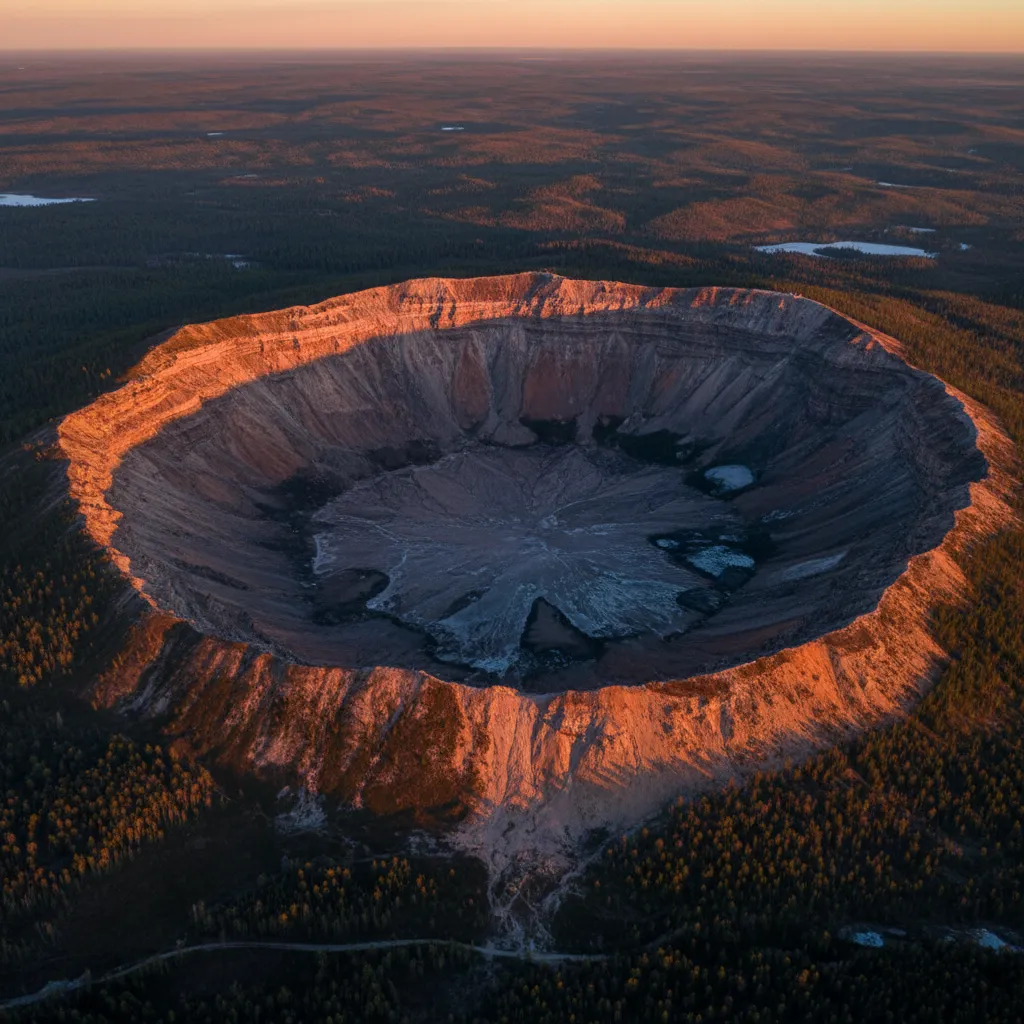
Imagine a colossal gash in the Earth, stretching for a mile across the desolate Siberian wilderness. A terrifying, ever-widening abyss that locals call the "Mouth to Hell," or sometimes, the "Gateway to the Underworld." This isn't a scene from a sci-fi movie; it's the Batagaika Crater, a geological marvel and a stark warning, growing larger every single year in Russia's remote Sakha Republic. If you thought you knew all the incredible places on our planet, prepare to have your mind blown by this hidden destination that’s literally unearthing a prehistoric world beneath your feet.
What is the Batagaika Crater? A Scar on Earth's Face
The Batagaika Crater is not your typical impact crater or volcanic caldera. It's a thermokarst depression, the largest of its kind on Earth, and it's a testament to the immense power of thawing permafrost. Picture a vast, bowl-shaped valley, roughly 1 kilometer (0.6 miles) long and up to 100 meters (328 feet) deep, with a continuously collapsing headwall that looks like a gigantic, serrated smile on the landscape. This 'megaslump' began forming in the 1960s after a section of forest was cleared, leading to the ground losing its insulating tree cover. Coupled with rising global temperatures, the permafrost—ground that has been continuously frozen for thousands of years—began to melt, causing the land to subside dramatically.
What makes Batagaika truly unique is its scale and its relentless expansion. It grows by an estimated 10-30 meters (33-98 feet) annually, devouring the surrounding taiga forest. This isn't just a slow, geological process; it's a dynamic, rapidly changing landscape that gives you a visceral sense of the Earth's fragility and resilience. Seen from above, it truly looks like a raw, bleeding wound on the planet's surface, a geological spectacle unlike anything else you've ever witnessed.

A Window to the Past: Unearthing Ancient Secrets
Beyond its terrifying appearance, the Batagaika Crater is an unparalleled scientific treasure trove. As the ancient permafrost thaws and the crater expands, it doesn't just reveal dirt; it exposes layers of Earth's history, perfectly preserved for tens of thousands of years. Imagine walking along its ever-shifting floor and seeing the perfectly preserved remains of ancient forests, some dating back 120,000 to 200,000 years, still standing upright as if they were frozen in time. These aren't just fossilized impressions; they are actual trees, branches, and leaves, emerging from their icy slumber.
Even more astonishing are the prehistoric animal remains that have been unearthed. Scientists have discovered well-preserved carcasses of Ice Age megafauna, including woolly mammoths, ancient horses, bison, and even a 42,000-year-old foal, remarkably intact with its hair, hooves, and internal organs still present. These incredible finds offer an unprecedented, raw window into the Last Glacial Period, providing invaluable insights into the ecosystems, climate, and life forms that roamed Siberia countless millennia ago. Each new collapse of the crater wall is a potential lottery ticket for paleontologists, revealing secrets that have been locked away in ice for epochs.
The Unsettling Present: A Stark Indicator of Climate Change
While the prehistoric revelations are breathtaking, the very existence and rapid expansion of the Batagaika Crater serve as a stark, visual indicator of our planet's changing climate. It's a living, breathing laboratory for understanding the effects of global warming on permafrost regions, which cover a quarter of the Northern Hemisphere. As temperatures rise, more permafrost thaws, releasing vast amounts of greenhouse gases—methane and carbon dioxide—that were previously trapped in the frozen soil. This creates a dangerous feedback loop, where warming causes thawing, which releases more gases, leading to more warming.
Studying Batagaika allows researchers to predict future changes in permafrost landscapes worldwide and assess the potential impact on global climate patterns. It's a powerful, undeniable symbol of the challenges we face, a dramatic illustration of how human activity and natural processes are reshaping our planet on a scale we're only just beginning to comprehend. Visiting Batagaika, you don't just see a geological wonder; you witness climate change in action, a tangible manifestation of a global crisis.

The Alien Landscape: What You'll See There
Standing at the edge of the Batagaika Crater is an experience bordering on the surreal. The sheer scale is overwhelming, the air often filled with the sounds of creaking ice and collapsing earth. The exposed layers of soil, ranging from dark peats to lighter sands and silts, create a mesmerizing palette of earthy tones, tracing the geological timeline of the region. Some sections are covered in a thin, shimmering layer of ice, while others are wet and muddy, constantly shifting. It feels less like Earth and more like an alien world, a landscape ripped from the pages of an apocalyptic novel.
The main headwall, often referred to as the "Batagaika Megaslump," dominates the view. It's a towering, vertical cliff of frozen earth, constantly retreating, revealing fresh layers of ancient soil, ice wedges, and sometimes, the dark outlines of buried forests. Below, the crater floor is a chaotic mix of mudslides, meltwater streams, and newly exposed ground, a dynamic environment where the past is literally bubbling to the surface. It's a place that evokes both profound wonder at the Earth's processes and a chilling sense of its vulnerability.
Journey to the Mouth of Hell: Practicalities for the Intrepid
Let's be clear: the Batagaika Crater is not a tourist destination in the traditional sense. It's a remote, challenging, and largely inaccessible site, primarily visited by scientific expeditions. Located deep within the Sakha Republic (Yakutia), one of the coldest inhabited regions on Earth, reaching it requires significant planning, specialized equipment, and a robust spirit of adventure.
Accessibility: The nearest major settlement is Batagay, a small town. From there, access to the crater itself typically involves off-road vehicles, ATVs, or even helicopters, depending on the season and ground conditions. There are no marked trails or visitor facilities. This is truly an expedition into the wild, requiring experienced local guides who understand the terrain and the inherent dangers of unstable ground.
Permits and Research: Gaining access often requires special permits, especially if you intend to conduct research or spend extended time at the site. Most visits are part of organized scientific endeavors. For the truly intrepid adventurer, joining a reputable expedition or arranging a highly specialized tour with local experts would be the only viable (and safe) option.
Conditions: Expect extreme weather. Summers are brief and can be surprisingly warm, leading to rapid thawing and muddy conditions. Winters are brutally cold. The ground is unstable, with active erosion and potential landslides, making safety paramount. This is a place for those who are physically fit, well-prepared for wilderness survival, and respectful of the environment and its scientific importance.

Is Batagaika Crater on Your Bucket List?
The Batagaika Crater stands as one of the most extraordinary and compelling natural wonders on our planet. It's a place where deep time is laid bare, where the echoes of the Ice Age whisper from thawing ice, and where the urgent realities of climate change are etched into the very landscape. It's not a place for a casual visit, but for those who seek the profound, the challenging, and the truly unique, the "Mouth to Hell" offers an unparalleled journey to the edge of discovery and into the heart of our planet's past, present, and uncertain future.
If you're drawn to the raw power of nature, the thrill of scientific discovery, and the sobering truth of environmental change, then the Batagaika Crater, this magnificent scar on Earth's face, might just be the most unforgettable destination you could ever imagine.
Essential Travel Information
- Location Batagaika Crater (Батагайка кратер), Russia
- Best Time Late spring to early autumn (June-September) for warmer, albeit muddy, conditions. Winter for extreme cold and frozen ground access, but very challenging.
- Getting There Fly to Yakutsk (YKS), then a domestic flight to Batagay (BQY). From Batagay, highly specialized off-road vehicle or helicopter transport with local guides is required.
- Airport Batagay Airport (BQY)
- Budget Luxury (due to extreme remoteness, specialized transport, and guide costs) - approximate daily cost would be several hundred to over a thousand USD depending on expedition type.
- Language Russian, Yakut (Sakha)
Find Places to Stay Near Batagaika Crater (Батагайка кратер)
Compare hotels, hostels, and unique stays in Russia.
Search AccommodationTours & Experiences Near Batagaika Crater (Батагайка кратер)
Book guided tours, day trips, and unique experiences.
Browse Tours