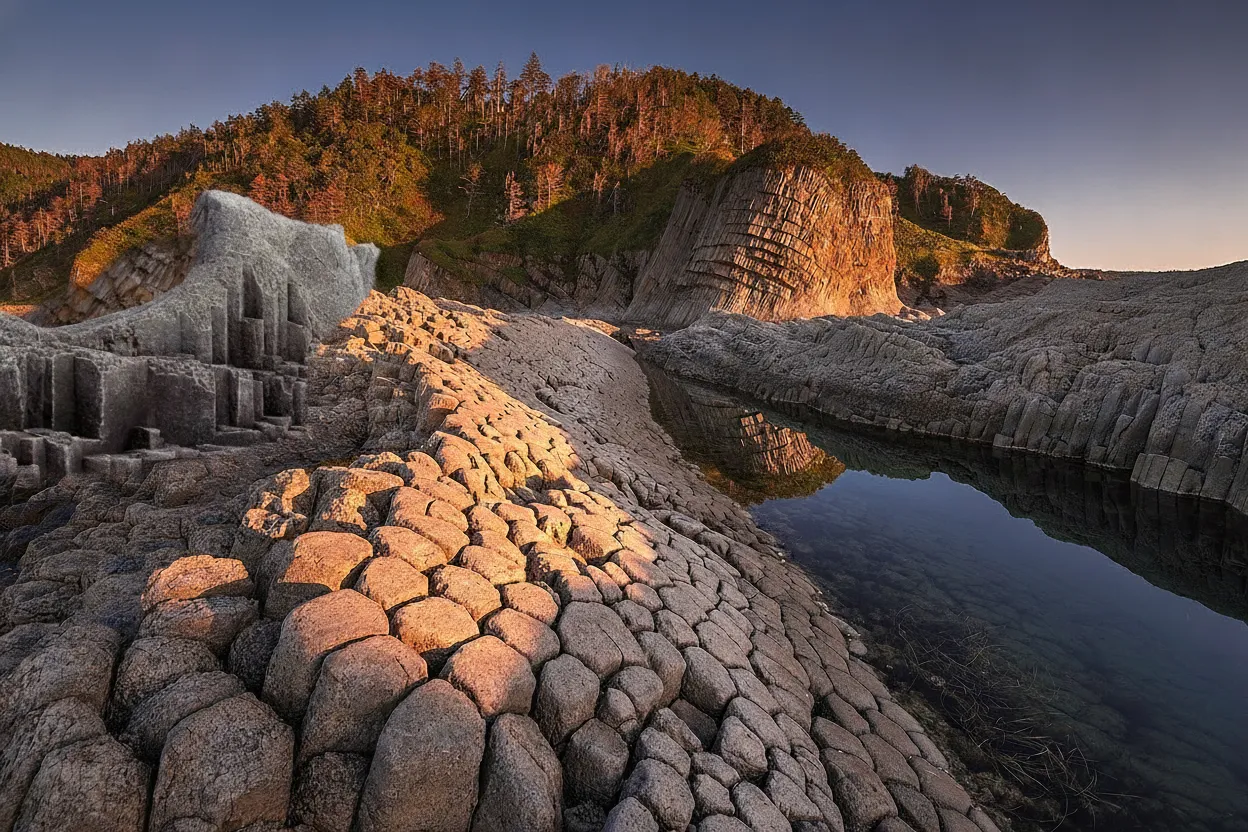
Imagine stumbling upon a geological marvel so striking, so impossibly perfect, that it makes you question if you've somehow been transported to another continent. A place where the raw power of Earth’s ancient heart has sculpted the very land into an art form, mirroring one of the world's most famous natural wonders, yet hidden away at the literal edge of the Pacific. This isn't a dream, nor is it a trick of the light. It's Cape Stolbchaty (Мыс Столбчатый), a remote volcanic cape in Russia's far east, where nature plays its grandest symphony with hexagonal basalt columns, looking as if the legendary Giant's Causeway was transplanted to the mystical, mist-shrouded Kuril Islands.
For those of us who chase the world's most unexpected and visually stunning geological freaks, Cape Stolbchaty is the ultimate prize. It's a place that whispers tales of volcanic fury and tectonic shifts, a testament to nature's incredible ability to mimic itself across vast distances, reminding us that true beauty often lies in the most inaccessible corners of our planet. Get ready to embark on a journey to a destination so captivating, it will forever redefine your understanding of Earth's artistry.
What Makes Cape Stolbchaty So Special?
At first glance, the sight of Cape Stolbchaty is almost disorienting. Emerging from the turbulent waters of the Okhotsk Sea, on the western coast of Kunashir Island, is an astonishing panorama of towering, perfectly formed hexagonal basalt columns. These aren't just rocks; they're the frozen tears of a volcanic eruption, meticulously arranged by the slow, deliberate cooling of lava millions of years ago. The columns rise in intricate, stair-like formations, some plunging directly into the crashing waves, others forming dramatic cliffs and natural platforms that invite awe and contemplation.
What truly elevates Cape Stolbchaty from merely "beautiful" to "utterly extraordinary" is its striking resemblance to Northern Ireland's Giant's Causeway. Both are masterpieces of columnar jointing, a geological phenomenon where lava contracts and cracks into polygonal shapes as it cools. Yet, while the Giant's Causeway is a well-trodden path, Cape Stolbchaty remains a whispered secret, a pristine example of nature's raw power in a rarely visited corner of the world. It’s a stunning example of nature mimicking itself across continents, cloaked in the mist and mystery of the disputed Kuril Islands, making it one of the most unexpected and visually stunning geological freaks on Earth.
The sheer scale here is breathtaking. Some columns reach dozens of meters high, their dark, almost black surfaces starkly contrasted by the white foam of the sea and the occasional splash of vibrant green moss. The geometric precision against the wild, untamed backdrop of the Pacific makes for a scene that feels both ancient and otherworldly. It's a place where you can truly feel the pulse of the planet, where geological time unfolds before your very eyes.

A Glimpse into its History and Formation
The story of Cape Stolbchaty is written in fire and ice, millions of years in the making. Geologically, the Kuril Islands are part of the Pacific Ring of Fire, a horseshoe-shaped belt of volcanoes and seismic activity that arcs around the Pacific Ocean. This region is a hotbed of tectonic plate interaction, where the Pacific Plate subducts beneath the Okhotsk Plate, leading to frequent volcanic eruptions and earthquakes.
Cape Stolbchaty itself is believed to have formed from an ancient volcanic eruption, likely from the nearby Mendeleev Volcano, an active stratovolcano that dominates the landscape of Kunashir Island. As molten basaltic lava flowed across the surface, it began to cool. The magic happens during this cooling process: as the lava contracts, stress builds up, causing it to crack. In certain conditions, particularly when cooling occurs uniformly and relatively slowly, these cracks propagate in a hexagonal pattern, forming the distinctive columns we see today.
While the geological history is clear, the human history of Cape Stolbchaty is more elusive, reflecting the wild and untamed nature of the Kuril Islands. The islands were historically inhabited by the indigenous Ainu people, who lived in harmony with the rugged landscape. Later, they became a focal point of contention between Russia and Japan, a geopolitical chess game that continues to this day. This "disputed territory" status has inadvertently contributed to the cape's pristine, untouched quality, as access has historically been challenging and restricted.
The name "Stolbchaty" itself is Russian for "columnar," a straightforward and fitting description given its defining feature. It speaks to a time when explorers and cartographers, encountering this natural wonder, simply named it for what it was—an unforgettable landscape of towering columns, a testament to Earth's profound and ancient processes, largely untouched by the march of human civilization.
What You'll See and Experience There
Visiting Cape Stolbchaty is an experience for the senses, an immersion in raw, untamed nature. As you approach, whether by a bumpy off-road vehicle or a boat skirting the coastline, the scale of the columns slowly reveals itself, growing more impressive with every moment. The air is crisp, often carrying the scent of the sea and the damp earth. The sound of waves crashing against the basalt pillars is a constant, rhythmic soundtrack to this wild symphony.
The columns themselves are the undisputed stars. You'll marvel at their geometric perfection, some standing vertically like ancient sentinels, others tilted, creating a natural staircase down to the water. The dark basalt, wet from the sea spray, gleams in the sunlight (if you're lucky enough to catch it), revealing subtle hues of green from algae and moss. At low tide, you might even be able to walk among the lower sections, offering a unique perspective and a chance to truly appreciate the intricate patterns.

Beyond the columns, the surrounding landscape of Kunashir Island is equally captivating. Rugged cliffs, pebble beaches, and dense, subarctic vegetation characterize the coastline. Keep an eye out for wildlife: the Kuril Islands are a haven for numerous species of seabirds, including puffins, gulls, and cormorants, which often nest on the cliffs. You might also spot seals basking on rocks or playing in the waves. The island's interior, if you venture further, is home to brown bears and a unique array of flora, adding to the sense of wilderness.
The atmosphere at Cape Stolbchaty is one of profound isolation and wonder. The frequent mists and changeable weather only add to its mystique, cloaking the columns in an ethereal veil that makes them appear even more ancient and mysterious. This isn't a place for casual tourism; it's a destination for adventurers, photographers, and those who seek to connect with the planet's most dramatic and untouched natural spectacles. It's a place to stand in quiet awe, contemplating the immense forces that shaped our world.
Practical Tips for Visiting This Remote Gem
Let's be clear: a trip to Cape Stolbchaty is an expedition, not a holiday. This is one of the most remote and logistically challenging destinations you can imagine, but for the intrepid traveler, the reward is immeasurable.
1. Permits and Access: The Kuril Islands are a border zone, and special permits are required for foreign visitors. This process can be lengthy and complex, often requiring several months of advance planning through a specialized tour operator. Independent travel is virtually impossible due to these restrictions and the lack of infrastructure.
2. Best Time to Visit: The short summer season, typically late July to early September, offers the best chance of milder weather and clearer skies, though conditions can change rapidly. Outside of these months, rough seas, heavy snow, and extreme cold make travel extremely difficult or impossible.
3. How to Get There:
- Fly to Yuzhno-Sakhalinsk (UUS): Your journey begins by flying to the capital of Sakhalin Oblast, Yuzhno-Sakhalinsk, from major Russian cities like Moscow or Vladivostok.
- Ferry to Kunashir Island: From Yuzhno-Sakhalinsk, you'll need to take a ferry to Kunashir Island, specifically to the main settlement of Yuzhno-Kurilsk. This ferry journey can be long (18-24 hours) and subject to weather delays.
- On Kunashir: From Yuzhno-Kurilsk, Cape Stolbchaty is still a challenging journey. You'll need to arrange off-road transport (like a powerful 4x4 or ATV) with a local guide. The roads are often unpaved, muddy, and rugged. The final approach usually involves a hike along the coast, which can be slippery and uneven. Some tours might also involve boat transfers along the coast, weather permitting.
4. Accommodation: Options on Kunashir Island are very basic. Expect simple guesthouses or homestays in Yuzhno-Kurilsk. Camping might be an option if organized by your tour operator, offering a truly immersive wilderness experience.
5. Essential Gear: Pack for all types of weather, even in summer. Layered, waterproof, and windproof clothing is crucial. Sturdy, waterproof hiking boots with good ankle support are a must for navigating the rocky terrain. Don't forget a high-quality camera with protection from moisture, binoculars for wildlife spotting, a first-aid kit, and plenty of snacks and water.
6. Safety and Respect: This is a wild place. Always travel with experienced local guides. Be aware of potential wildlife (bears can be present on Kunashir, though less likely directly at the cape, general precautions for the region apply). Leave no trace of your visit, respecting the pristine environment and its delicate ecosystems.

A journey to Cape Stolbchaty is more than just a trip; it's an odyssey into the heart of geological wonder and profound wilderness. It’s a chance to witness one of Earth’s most spectacular natural designs in a setting that few will ever experience. If you’re yearning for an adventure that pushes boundaries and rewards with unparalleled natural beauty, then Cape Stolbchaty awaits, ready to etch its unforgettable image into your memory forever.
Essential Travel Information
- Location Cape Stolbchaty (Мыс Столбчатый), Russia
- Best Time Late July to early September
- Getting There Fly to Yuzhno-Sakhalinsk (UUS), then ferry to Kunashir Island (Yuzhno-Kurilsk), followed by organized off-road vehicle/boat and hike with a guide.
- Airport Yuzhno-Sakhalinsk Airport (UUS)
- Budget Luxury (due to logistics and specialized tour costs, approx. $500-1000+ USD per day for all-inclusive guided expeditions)
- Language Russian
Find Places to Stay Near Cape Stolbchaty (Мыс Столбчатый)
Compare hotels, hostels, and unique stays in Russia.
Search AccommodationTours & Experiences Near Cape Stolbchaty (Мыс Столбчатый)
Book guided tours, day trips, and unique experiences.
Browse Tours