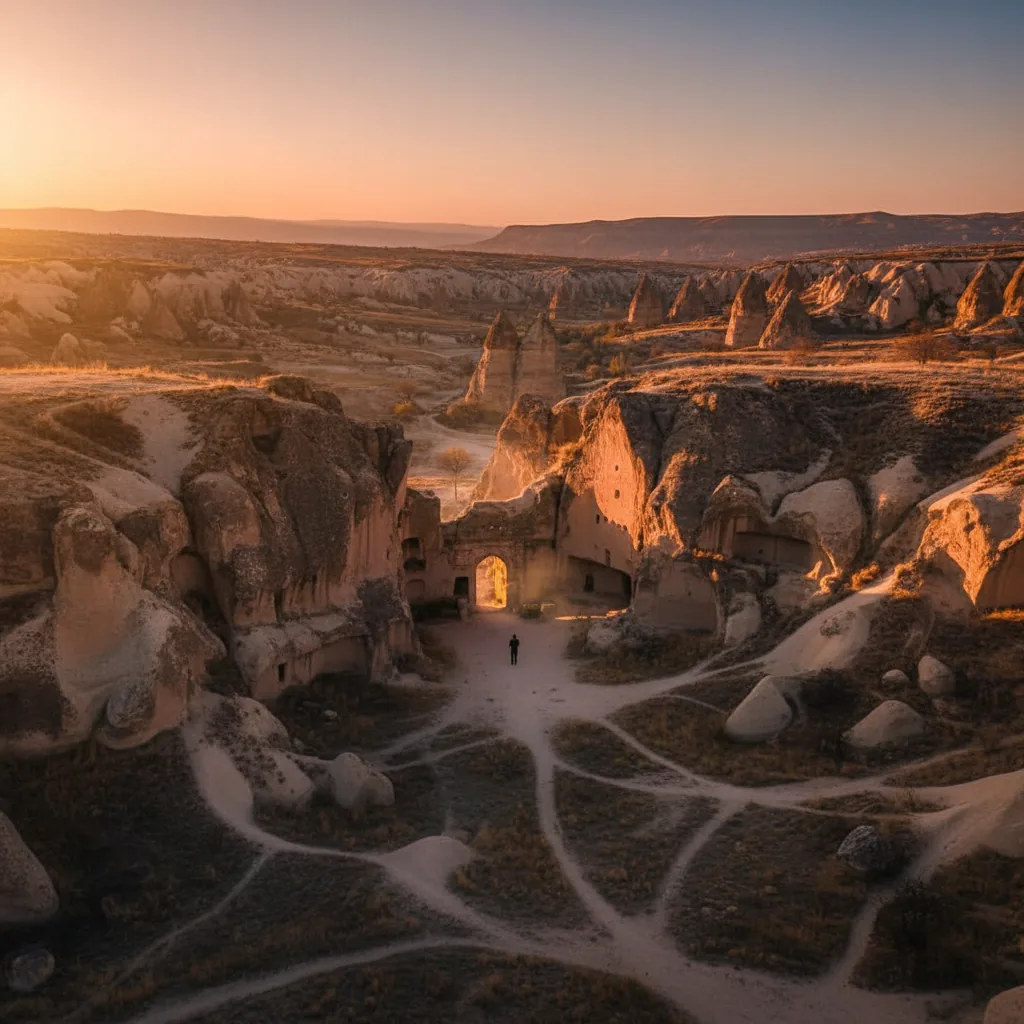
Imagine this: You stir from a deep sleep, not to the blare of an alarm, but to a soft, ethereal glow filtering through your cave hotel window. You step out onto your balcony, and your breath catches. Before you, a sky dotted with hundreds of vibrant hot air balloons, like giant, painted jewels, slowly ascends over an otherworldly landscape. Below, an ancient tableau of 'fairy chimneys' – towering, whimsical rock formations – stretches into the distance, interspersed with the entrances to centuries-old cave dwellings. This isn't a dream, nor is it a scene from a sci-fi movie. This, my friend, is a typical morning in Cappadocia, Turkey, a place so uniquely magical it will redefine your idea of a travel destination.
I've been lucky enough to explore many corners of our beautiful planet, but few places have captivated my imagination quite like Cappadocia. Tucked away in the heart of Central Anatolia, it's a region that seems to have been sculpted by the hands of giants and then lovingly carved out by generations of human ingenuity. If you're yearning for an adventure that combines stunning natural beauty, a profound sense of history, and experiences that will leave you speechless, then pack your bags – Cappadocia is calling.
What Makes Cappadocia Truly Special?
At the heart of Cappadocia's allure are its mind-boggling geological formations. These aren't just any rocks; they are the legendary 'fairy chimneys.' Picture this: millions of years ago, powerful volcanic eruptions blanketed the region in thick layers of ash and lava. Over eons, the softer volcanic tuff was eroded by wind and water, leaving behind the harder basalt caps that protect the columns beneath. The result? A landscape unlike anything else on Earth – an undulating tapestry of cones, pillars, mushrooms, and even phallic shapes, each telling a silent story of geological time.
But Cappadocia isn't just about the rocks. What truly elevates its status as a world-class destination is how humanity has intertwined with this bizarre terrain. Early civilizations, recognizing the soft, easily workable nature of the rock, began carving into it. They didn't just build homes; they chiseled out entire villages, elaborate churches adorned with frescoes, and even vast, multi-level underground cities that could house thousands. This isn't just a place to observe history; it's a place to live it, to touch the cool stone walls that have sheltered countless lives, and to imagine the echoes of ancient prayers in hidden chapels.
And then, there's the iconic hot air balloon experience. While many places offer balloon flights, nowhere does it feel quite as essential or as breathtaking as in Cappadocia. To float silently above this surreal canvas as the sun paints the sky in hues of orange and pink, watching hundreds of other balloons rise around you, is a moment that transcends mere sightseeing. It’s an emotional, spiritual experience that imprints itself on your soul.

A Journey Through Time: Cappadocia's Rich History
The story of Cappadocia is etched not just in its rocks, but in the annals of human civilization. While the geological formations took millions of years to sculpt, human interaction dates back thousands. The Hittites were among the earliest known inhabitants, followed by the Persians, whose name for the region, "Katpatuka," meant "land of beautiful horses." Later, it fell under Roman rule, becoming a vital crossroads for trade and culture.
However, it was during the early Christian period that Cappadocia truly flourished as a haven. Facing persecution from Roman authorities, early Christians found refuge in the region's soft rock, carving out hidden churches and monastic complexes. These rock-cut sanctuaries, often decorated with vibrant frescoes, served as places of worship, education, and community. The Göreme Open-Air Museum stands as a testament to this era, a UNESCO World Heritage site preserving dozens of churches and chapels.
But perhaps the most astounding historical marvels are the underground cities. As invasions became more frequent and dangerous, the inhabitants of Cappadocia developed an ingenious solution: they dug deeper. Cities like Kaymaklı and Derinkuyu plunge multiple levels below the surface, complete with ventilation shafts, stables, kitchens, storage rooms, and even churches, all protected by massive rolling stone doors. These subterranean marvels offered refuge for thousands, allowing entire communities to live underground for months at a time, a testament to their resilience and architectural prowess.
From Byzantine monks to Seljuk Turks and eventually the Ottoman Empire, Cappadocia has witnessed a parade of cultures, each leaving its mark on this extraordinary landscape. Today, you can literally walk through these layers of history, touching the past with your own hands.
What You'll See and Do in This Magical Land
Cappadocia offers a plethora of activities, each promising a unique perspective on its wonders. Here’s a glimpse of what awaits you:
The Unforgettable Hot Air Balloon Ride
This is non-negotiable. Wake up before dawn, get picked up by your tour operator, and watch as hundreds of balloons inflate, their burners roaring to life against the pre-sunrise darkness. As you ascend, the world unfolds beneath you – the valleys, the fairy chimneys, and the rising sun painting the sky and landscape in an unforgettable palette. It’s a serene, almost spiritual experience, culminating in a celebratory toast upon landing. Book this well in advance!
Explore the Valleys and Fairy Chimneys
Put on your walking shoes and get ready to hike! Each valley offers a distinct charm. **Love Valley** is famous for its phallic-shaped chimneys (hence the name!), while **Devrent Valley**, also known as "Imagination Valley," features rock formations that resemble animals and other figures – use your imagination! **Pasabag (Monks Valley)** is where you’ll find some of the most iconic multi-headed fairy chimneys, once home to hermits. You can explore these on foot, by ATV, or even on horseback.

Delve into Ancient Cave Dwellings and Churches
A visit to the **Göreme Open-Air Museum** is like stepping into a living history book. This UNESCO site is a cluster of rock-cut churches and monasteries, many featuring remarkably preserved frescoes depicting biblical scenes. You’ll be awestruck by the artistry and the sheer effort involved in carving these sacred spaces. Beyond Göreme, explore the villages of Uçhisar and Ortahisar, where you can climb their respective castle-like rock formations for panoramic views, and discover more cave homes, some still inhabited.
Journey into Underground Cities
Prepare to be amazed by the ingenuity of ancient civilizations. Descend into the multi-level subterranean cities of **Kaymaklı** or **Derinkuyu**. These vast networks of tunnels, rooms, and passages were carved by hand and served as refuge from invaders. As you navigate the narrow corridors, you'll gain a profound appreciation for the resourcefulness of those who lived there. It’s a cool, slightly claustrophobic, but utterly fascinating experience.
Discover Local Crafts and Culture
Visit **Avanos**, a town famous for its pottery, where you can watch artisans craft beautiful ceramics from the local red clay. Many workshops offer hands-on experiences. Don't forget to savor the delicious local cuisine – think hearty stews, fresh salads, and delectable pastries – often served in charming cave restaurants.

Practical Tips for Your Cappadocia Adventure
To make your trip as smooth and enjoyable as possible, here are a few practical tips:
Best Time to Visit: The shoulder seasons of **Spring (April-May)** and **Autumn (September-October)** offer the most pleasant weather for exploring and the highest chance of successful balloon flights. Summers can be very hot, and winters can be cold with snow, though a snow-covered Cappadocia is undeniably beautiful.
How to Get There: The easiest way is to fly into **Kayseri Erkilet Airport (ASR)** or **Nevşehir Kapadokya Airport (NAV)**. Both are well-connected to Istanbul. From the airports, numerous shuttle services, taxis, or pre-booked transfers can take you to your accommodation in Göreme, Uçhisar, or Avanos.
Accommodation: Treat yourself to a **cave hotel**! Many traditional cave dwellings have been beautifully converted into luxurious and atmospheric hotels, offering a truly unique stay experience.
Booking Hot Air Balloons: Book your balloon flight several months in advance, especially if you're traveling during peak season. Flights are weather-dependent, so consider booking for your first full day in Cappadocia to allow for rebooking if there's a cancellation.
Getting Around: While you can walk around Göreme, exploring the wider region often requires transport. Options include organized tours (often categorized as Red, Green, and Blue routes), renting a car, hiring a private driver, or exploring by ATV or horse riding.
What to Pack: Layers are key, as temperatures can vary throughout the day. Sturdy walking shoes are a must for exploring valleys and ancient sites. Don't forget your camera, extra batteries, and a power bank – you'll be taking a lot of photos!
Cappadocia is more than just a destination; it's an experience that awakens the senses and ignites the imagination. It’s a place where history whispers from every rock face, and every sunrise paints a masterpiece. So, if you're ready for an adventure that will leave you utterly spellbound, start planning your trip to this incredible corner of Turkey. You won't regret it.
Essential Travel Information
- Location Cappadocia, Turkey
- Best Time Spring (April-May) and Autumn (September-October)
- Getting There Fly into Kayseri Erkilet Airport (ASR) or Nevşehir Kapadokya Airport (NAV). Shuttle services are readily available to Göreme or other towns.
- Airport Kayseri Erkilet Airport (ASR) or Nevşehir Kapadokya Airport (NAV)
- Budget Mid-range (approx. $70-150 USD per day, excluding balloon flight)
- Language Turkish
Find Places to Stay Near Cappadocia
Compare hotels, hostels, and unique stays in Turkey.
Search AccommodationTours & Experiences Near Cappadocia
Book guided tours, day trips, and unique experiences.
Browse Tours