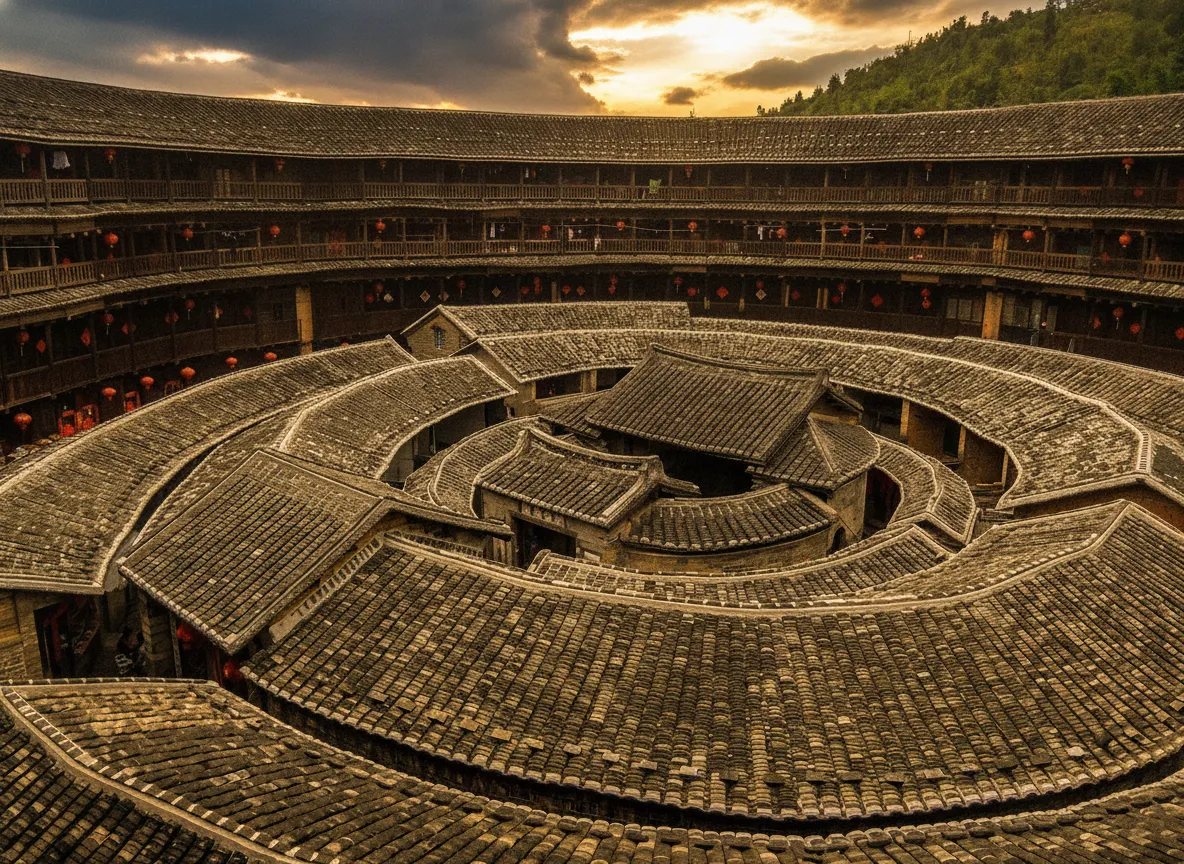
Imagine stepping inside a colossal, circular earth fortress that has housed generations of a single clan for centuries, a living labyrinth where every wall tells a story. Forget crowded tourist traps and well-trodden paths; this is an invitation to uncover a true architectural marvel, a hidden world nestled deep in the lush, emerald hills of China's Fujian Province. We're talking about Chengqi Lou (承启楼), a place so extraordinary it feels plucked from the pages of a fantasy novel, yet it’s a vibrant, breathing community where ancient traditions thrive alongside modern life. If you've ever dreamt of discovering a place where history isn't just preserved but actively lived, then pack your bags, because Chengqi Lou, the undisputed 'King of Tulou,' is waiting to reveal its secrets.
Chengqi Lou: The King of Tulou and a Vertical Village
This isn't just a building; it's an entire universe contained within four massive, concentric rings. Chengqi Lou is the epitome of a Hakka Tulou – a unique type of earthen building found exclusively in this part of China. But even among these architectural wonders, Chengqi Lou stands supreme. Nicknamed the "King of Tulou," it's a testament to ingenious design, communal spirit, and formidable defense. Picture this: a towering circular structure, 73 meters in diameter, rising four stories high, its thick rammed-earth walls providing insulation against the elements and an impenetrable barrier against intruders. This isn't a museum piece; it's a living, breathing testament to an ancient way of life, still inhabited by descendants of the original clans.
Inside, ring after ring of living quarters, a central ancestral hall, wells, and communal spaces create a self-contained vertical village. It’s a place where hundreds of rooms open onto shared walkways, fostering a tight-knit community where families have lived side-by-side for generations, sharing meals, stories, and the rhythms of daily life. The architectural genius lies not just in its scale but in its functionality: a design that maximized defense while fostering an incredibly strong sense of clan identity and mutual support. It’s a true marvel of sustainable and communal living, centuries ahead of its time.

Whispers of History: The Hakka People and Their Earthen Fortresses
To truly appreciate Chengqi Lou, we need to understand the Hakka people. "Hakka" literally means "guest families," a name given to Han Chinese migrants who moved south from central China centuries ago, seeking refuge from wars and unrest. As newcomers in unfamiliar lands, they faced challenges, including hostility from existing communities and rampant banditry. This necessity for defense, combined with a strong sense of clan solidarity, gave birth to the Tulou.
These massive, fortress-like homes allowed entire clans to live together, creating a safe haven and a microcosm of society. Chengqi Lou, built in the early 18th century during the Qing Dynasty, is one of the grandest examples of this architectural innovation. Its design, with a single main entrance and defensible windows only on the upper floors, speaks volumes about the turbulent times in which it was constructed. The thick, windowless lower walls were resistant to fire and attack, while the upper floors provided vantage points for observation and defense, making these buildings virtually impregnable.
In 2008, the Fujian Tulou, including Chengqi Lou, were collectively inscribed as a UNESCO World Heritage Site. This international recognition cemented their status as "exceptional examples of a building tradition and function, exemplifying a particular type of communal living and defensive organization." It’s a powerful acknowledgment of their universal value, not just as buildings, but as living cultural landscapes that tell a compelling story of human ingenuity and resilience.
What You'll See (and Feel) Inside Chengqi Lou
Stepping through the massive wooden gate of Chengqi Lou is like crossing a threshold into another dimension. The first thing that strikes you is the sheer scale. The outermost ring, a towering wall of earth, gives way to a spacious courtyard, then another ring, and another, until you reach the central ancestral hall – the spiritual and social heart of the community. It’s a dizzying yet captivating experience, as the architecture unfolds before your eyes, layer by intricate layer.
Wander through the ground floor, and you'll find kitchens, storerooms, and small workshops. The aroma of cooking, the sounds of daily chores, and the gentle murmur of conversations create an immediate sense of immersion. Look up, and you'll see intricate wooden balconies and staircases spiraling upwards, connecting hundreds of rooms. Each family typically occupies a vertical section, spanning multiple floors, with living spaces and bedrooms designed to maximize light and ventilation within the unique structure.

The air is alive with the sounds of daily life: the gentle clatter of woks, the chatter of children playing in the courtyards, the murmur of conversations carried across shared walkways. You might find residents selling local produce, handcrafted souvenirs, or offering cups of fragrant Fujian tea from small, impromptu stalls. The central courtyard often hosts small markets, and the ancestral hall, with its ornate carvings and altars, remains a place of quiet reverence and family gatherings.
For a truly unforgettable perspective, climb to the upper floors (some are accessible to visitors, often for a small fee). From above, you can gaze down into the inner rings, appreciating the intricate layout and the profound sense of community it fosters. It’s a breathtaking panorama, offering a unique perspective on this ancient vertical village. You’ll witness the ingenious planning that allowed hundreds of people to live together harmoniously, protected from the outside world. Every corner, every weathered timber, every stone tells a story of generations lived within these walls, a testament to enduring heritage and a vibrant future.

Practical Tips for Your Journey to Chengqi Lou
Ready to embark on this incredible journey? Here’s what you need to know to make your visit to Chengqi Lou and the Fujian Tulou region as smooth and enriching as possible:
Getting There: Chengqi Lou is located in Gaobei Village, Yongding District, Longyan City, Fujian Province. The easiest way to reach the Fujian Tulou region is typically by high-speed train to Longyan (Longyan Railway Station) or directly to the Yongding Tulou Station. From there, local buses, taxis, or pre-arranged private drivers can take you to Gaobei Tulou Cluster, where Chengqi Lou is the undisputed star attraction. The journey through the lush, terraced landscapes is an experience in itself.
Best Time to Visit: Spring (March to May) and Autumn (September to November) offer the most pleasant weather for exploring. The temperatures are mild, and the surrounding countryside is at its most beautiful. Summers can be hot and humid, while winters are mild but might be damp, so pack accordingly.
Accommodation: While you can’t stay *inside* Chengqi Lou itself (it’s a private residence), many smaller, modernized Tulou in the surrounding clusters offer guesthouse accommodations. Staying in a renovated Tulou is an unforgettable experience, allowing you to immerse yourself in the unique atmosphere and Hakka culture. Alternatively, there are hotels and guesthouses in the nearby towns of Hukeng or Yongding.
Respectful Exploration: Remember, Chengqi Lou is a living community, not just a tourist attraction. Be mindful of residents' privacy, especially when taking photos. Always ask permission before taking close-up photos of individuals, and keep noise levels down, particularly in residential areas. Support the local economy by purchasing goods from the residents – it’s a direct way to contribute to the preservation of their heritage.
What to Bring: Comfortable walking shoes are a must, as you’ll be doing a lot of exploring on uneven surfaces. A good camera is essential to capture the unique architecture and vibrant life. Sunscreen and a hat are advisable for sunny days, and a light jacket for cooler evenings. Don't forget an open mind and a sense of adventure – you're about to step into a truly unique corner of the world!
Local Cuisine: Don't leave without sampling authentic Hakka cuisine. Look for dishes like Hakka stuffed tofu, salted chicken, stewed pork with preserved vegetables, and various wild vegetable dishes. The food is hearty, flavorful, and a true reflection of the region's agricultural heritage and the ingenuity of its people. Many guesthouses offer home-cooked Hakka meals that are an absolute delight.
Chengqi Lou is more than just an architectural wonder; it's a living testament to a rich history, a vibrant culture, and an enduring community spirit. It’s an invitation to step off the beaten path and discover a place where the past is not just remembered, but actively lived. So, are you ready to unlock the secrets of the King of Tulou?
Essential Travel Information
- Location Chengqi Lou (承启楼), China
- Best Time Spring (March-May) and Autumn (September-November) for pleasant weather.
- Getting There High-speed train to Longyan or Yongding Tulou Station, then local transport (bus/taxi/private driver) to Gaobei Tulou Cluster.
- Airport Xiamen Gaoqi International Airport (XMN) or Fuzhou Changle International Airport (FOC), with connecting domestic flights or high-speed rail to Longyan.
- Budget Mid-range, approx. $50-100 USD per day (excluding long-distance travel), depending on accommodation and activities.
- Language Mandarin Chinese (Putonghua), Hakka dialect also spoken locally.
Find Places to Stay Near Chengqi Lou (承启楼)
Compare hotels, hostels, and unique stays in China.
Search AccommodationTours & Experiences Near Chengqi Lou (承启楼)
Book guided tours, day trips, and unique experiences.
Browse Tours