If you're anything like me, you're always on the hunt for those truly special places, the ones that make your heart pound with a sense of discovery. Gannarve Skeppssättning, or the Gannarve Stone Ship, is precisely one of those gems. It’s not just a historical site; it’s an experience, a journey back thousands of years to a time when the line between the physical world and the spiritual realm was beautifully, terrifyingly blurred. This isn't a place you simply "see"; it's a place you feel, a place that invites you to listen to the silent stories etched in stone and wind.
Gannarve Skeppssättning: A Ship of Stones on a Sea of Time
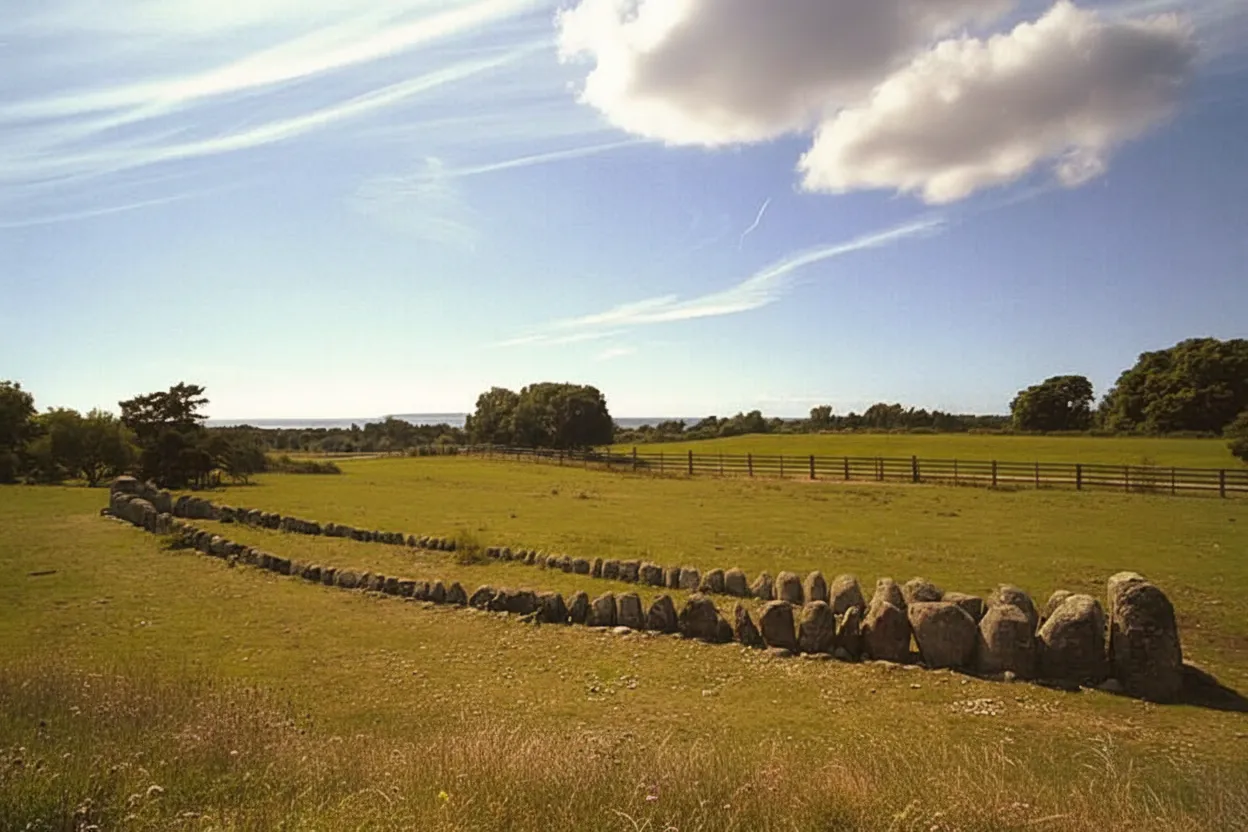
What makes Gannarve Skeppssättning so incredibly special isn't just its age – dating back to the Nordic Bronze Age and Iron Age – but its sheer evocative power. Picture this: dozens of meticulously placed boulders, some weighing tons, forming the distinct shape of a ship, complete with a defined bow and stern. It’s colossal, stretching over 50 meters in length, making it one of the largest and most impressive stone ships on Gotland, an island renowned for its abundance of these ancient monuments.
This isn't just a curious arrangement of stones; it’s a profound symbolic vessel. In ancient Nordic cultures, ships were central to life – for trade, exploration, and connecting distant lands. But they were also deeply intertwined with death and the afterlife. These stone ships, particularly those on Gotland, served as monumental burial sites, where the deceased were symbolically launched into the afterlife. It’s a hauntingly beautiful concept, a static ship ready for an eternal voyage, carrying souls from the earthly realm to whatever lay beyond.
The scale of human effort involved in its construction is mind-boggling. Imagine the community, without modern tools, moving and positioning these massive stones. It speaks volumes about the reverence and importance placed on these burial rites, signifying a belief system where the journey after death was as significant, if not more so, than life itself. Gannarve isn't just a monument; it’s a window into the spiritual world of our ancestors, a direct line to their hopes, fears, and understanding of the cosmos.

Whispers from the Bronze Age: The History Behind the Stone Ships
To truly appreciate Gannarve, we need to delve a little deeper into its historical context. The Nordic Bronze Age (roughly 1700-500 BCE) was a period of significant cultural development in Scandinavia. People lived in farming communities, but trade routes were expanding, bringing new ideas and technologies. This era saw the emergence of elaborate burial practices, reflecting a growing social hierarchy and complex religious beliefs. Ships, both real and symbolic, played a crucial role in their worldview.
The concept of the "sun ship" or "death ship" was prevalent, symbolizing the journey of the sun across the sky and the soul's passage through the underworld. These stone ships, therefore, weren't merely graves; they were cosmic vessels, ensuring the safe passage of the deceased. While Gannarve dates primarily to the Bronze Age, its use and significance likely continued into the Iron Age (500 BCE – 1050 CE), bridging the gap to what many commonly associate with the "Viking era." Indeed, these megalithic stone ships can be seen as powerful predecessors to the later, more famous ship burials of the Viking Age, sharing a common symbolic thread of a journey to the afterlife.
Gotland, the island where Gannarve resides, is particularly rich in these stone ships, boasting over 350 known examples. Why Gotland? Theories abound. Some suggest its strategic location in the Baltic Sea made it a vital trading hub, attracting diverse peoples and ideas. Others believe it held particular spiritual significance, perhaps a sacred landscape chosen for these elaborate burial monuments. Whatever the reason, walking among these ancient stones on Gotland feels like stepping onto sacred ground, a place where the veil between worlds is thin.

What You'll Discover at Gannarve: A Journey Through Time
Visiting Gannarve Skeppssättning is an immersive experience. As you approach across the open field, the sheer scale of the stone ship slowly reveals itself. The air, often crisp and carrying the scent of the sea, adds to the atmosphere. You’ll see the massive, weathered boulders, some standing upright, others slightly tilted, forming the distinct outline of a ship. The "bow" and "stern" stones are often larger and more prominent, giving a powerful sense of direction to this static vessel.
Walking the perimeter of the ship, or even stepping inside its "hull," you can almost hear the echoes of ancient ceremonies. Imagine the community gathering here, perhaps under a full moon or at a solstice, performing rituals to honor their dead and ensure their safe passage. The feeling is one of profound tranquility, yet also a powerful sense of the immense human history that unfolded on this very spot. It’s a place that encourages contemplation, inviting you to ponder the great mysteries of life and death that have captivated humanity for millennia.
While Gannarve itself is the main draw, the surrounding landscape of Gotland adds to the allure. Rolling fields, ancient forests, and the nearby Baltic Sea create a quintessential Swedish backdrop. You'll find yourself marveling not just at the monument, but at the enduring beauty of nature that has witnessed centuries of human endeavor. It's a reminder that even in our fast-paced modern world, there are still places where time seems to slow down, allowing us to connect with something much older and deeper than ourselves.
Planning Your Expedition: Practical Tips for Visiting Gannarve
Ready to embark on your own journey to Gannarve? Here’s what you need to know to make the most of your visit:
Getting There
Gannarve Skeppssättning is located on the island of Gotland, Sweden. The most common way to reach Gotland is by ferry from Nynäshamn (south of Stockholm) or Oskarshamn on the mainland to Visby, Gotland’s main city. You can also fly directly to Visby Airport (VBY) from several Swedish cities. Once on Gotland, renting a car is highly recommended as public transport to more remote sites like Gannarve is limited. From Visby, it’s about a 30-40 minute drive south on well-maintained roads. The site is usually well-signposted once you're in the vicinity.
Best Time to Visit
The shoulder seasons (late spring/early summer, May-June, and early autumn, September-October) are fantastic. The weather is generally pleasant, the island is less crowded than in peak summer, and the light can be incredibly atmospheric. Summer (July-August) offers warmer temperatures and longer daylight hours, but also more tourists. Winter can be starkly beautiful, offering solitude and a dramatic, windswept experience, though access might be more challenging depending on snow.
What to Bring
- Sturdy Shoes: You'll be walking across fields, so comfortable, waterproof footwear is a must.
- Layers: Even in summer, Gotland can be breezy. A windbreaker or light jacket is always a good idea.
- Camera: You’ll want to capture the unique beauty of this place.
- Water & Snacks: There are no facilities directly at the site.
- Respect: This is an ancient burial ground. Treat it with reverence. Do not climb on the stones or disturb the site in any way. Leave no trace.
Accessibility
The site is generally open access and free to visit. There are no paved paths, so expect uneven ground and grass. It might not be suitable for those with significant mobility challenges.
Combine Your Visit
Gotland is brimming with history! Make a day of it by combining your visit to Gannarve with other nearby attractions. Explore the medieval city walls and charming cobblestone streets of Visby, a UNESCO World Heritage site. Seek out other stone ships, like the one at Gnisvärd, or visit the dramatic sea stacks (rauks) along the coast. The island is a treasure trove of ancient history and natural beauty.

Gannarve Skeppssättning isn't just a destination; it's an invitation to connect with the deep past, to ponder the mysteries that have shaped human civilization. It's a place that reminds us of the ingenuity, the spiritual depth, and the enduring legacy of those who walked this earth millennia before us. So, if you're looking for a travel experience that transcends the ordinary, that stirs the soul and ignites the imagination, set your compass for Gotland and let the ancient stone ship of Gannarve guide you on an unforgettable journey.
Essential Travel Information
- Location Gannarve Skeppssättning (Gannarve Stone Ship), Sweden
- Best Time Late spring (May-June) and early autumn (September-October) for pleasant weather and fewer crowds.
- Getting There Fly or take a ferry to Visby, Gotland. Rent a car for a 30-40 minute drive south to Gannarve.
- Airport Visby Airport (VBY)
- Budget Mid-range (approx. $100-200 USD per day, excluding long-haul flights, for accommodation, food, and car rental on Gotland)
- Language Swedish
Find Places to Stay Near Gannarve Skeppssättning (Gannarve Stone Ship)
Compare hotels, hostels, and unique stays in Sweden.
Search AccommodationTours & Experiences Near Gannarve Skeppssättning (Gannarve Stone Ship)
Book guided tours, day trips, and unique experiences.
Browse Tours