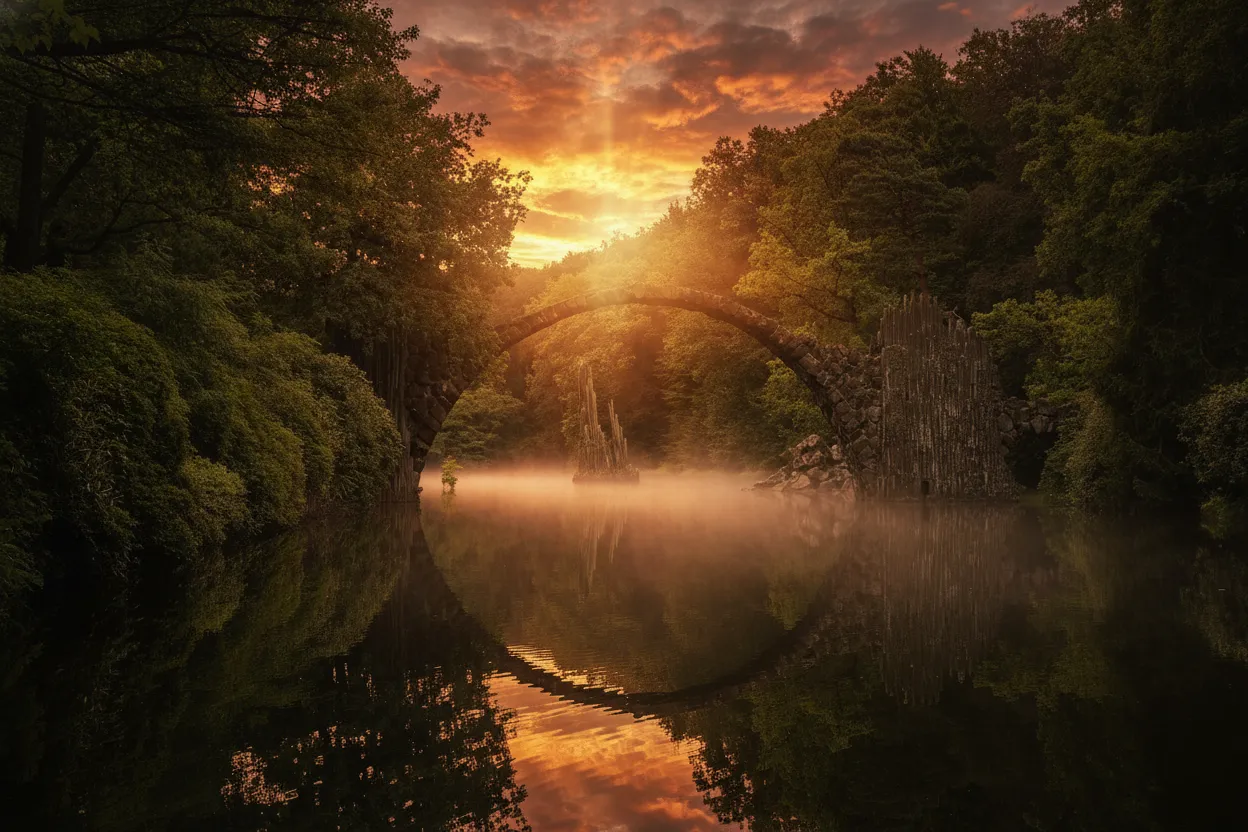
Imagine stumbling upon a place so utterly perfect, so unnervingly symmetrical, that it feels less like human artistry and more like a whisper from another realm. Deep within the lush, verdant heart of Saxony, Germany, lies such a marvel: Rakotzbrücke, better known as the Devil’s Bridge. This isn't just any old stone bridge; it's an optical illusion, a triumph of 19th-century design, and a portal to folklore. A perfectly circular arch, seemingly suspended in air, hovers above the tranquil Rakotzsee. When the waters are calm, its reflection completes an unbroken, flawless circle, an impossible feat of engineering that leaves visitors questioning reality. Are you ready to dive into the mystery of this hidden German gem?
Rakotzbrücke: Where Reality Bends and Legends Live
The magic of Rakotzbrücke isn't just in its age or its location; it's in its audacious defiance of the ordinary. This isn't a bridge built for crossing, but purely for aesthetic wonder, a grand folly designed to astound. Crafted from rugged, dark basalt columns and local fieldstone, its arch rises gracefully from the banks of the Rakotzsee, culminating in a dramatic, almost theatrical peak. But the true spectacle unfolds when you behold its reflection. The bridge was meticulously designed so that, when mirrored in the still, dark waters of the lake below, it forms a complete and utterly perfect circle. It's a breathtaking optical illusion, a testament to the vision of its creators, and a prime example of landscape architecture at its most whimsical.
This uncanny perfection is precisely why it earned the moniker "Devil's Bridge." Legend has it that such an impossibly precise structure could only have been built with supernatural aid, a pact with the Devil himself. The folklore often suggests that the builder, desperate to complete his masterpiece, promised the first soul to cross the bridge to the Devil. Of course, clever humans usually outsmarted the fiend, often by sending an animal across first. While the stories vary, the name "Teufelsbrücke" (Devil's Bridge) resonates deeply with the bridge's almost supernatural allure, making it a compelling spot for photographers, dreamers, and anyone seeking a touch of the extraordinary.
The basalt columns themselves add another layer of mystique. Their dark, almost menacing appearance, often described as "organ pipes," gives the bridge a primitive, powerful feel, as if it sprouted organically from the earth rather than being meticulously constructed. Standing before it, you can't help but feel a sense of awe, a quiet reverence for a place where nature and human ingenuity intertwine to create something truly unforgettable. It’s a photographer’s dream, especially during the golden hours of sunrise or sunset when the light plays tricks on the eye, enhancing the illusion and casting dramatic shadows.
A Nineteenth-Century Marvel: The Engineering Behind the Enchantment
The Rakotzbrücke, nestled within the expansive Azalea and Rhododendron Park Kromlau, isn't an ancient relic, but a product of 19th-century romanticism and a fascination with landscape design. It was commissioned around 1860 by Friedrich Hermann Rötschke, the local knight and owner of the Kromlau estate. Rötschke, an avid admirer of English landscape gardens, envisioned a park that would blend natural beauty with artistic follies, creating a wonderland for his visitors. The Rakotzbrücke was to be the crowning jewel of this vision, a bridge designed not for practical passage, but purely for its dramatic visual impact.
The construction itself was a monumental undertaking. Craftsmen meticulously arranged rugged basalt columns, many imported from distant quarries, to form the striking arch. The choice of basalt was deliberate; its dark, columnar structure mimicked natural geological formations, giving the bridge an almost primordial feel. The precision required to achieve the perfect parabolic curve that would complete a circle with its reflection is a testament to the skill and foresight of its builders. They didn't have modern CAD programs or laser levels; they relied on keen eyes, mathematical understanding, and generations of stonemasonry expertise.
Unlike many functional bridges, the Rakotzbrücke was always intended as a piece of art, a "Kapellenbrücke" or chapel bridge, though it never housed a chapel. It was designed to evoke wonder, to be a focal point within the sprawling, carefully curated landscape of Kromlau Park. This dedication to aesthetic perfection, rather than utilitarian purpose, is what makes the Rakotzbrücke truly unique. It stands as a powerful reminder of an era when wealthy landowners invested in creating breathtaking natural art, leaving behind legacies that continue to inspire awe centuries later. It's a piece of living history, not just for its age, but for the story it tells about human ambition and artistic vision.
Beyond the Bridge: Exploring Kromlau Park and Rakotzsee
While the Rakotzbrücke is undoubtedly the star attraction, the surrounding Azalea and Rhododendron Park Kromlau (Azaleen- und Rhododendronpark Kromlau) is a destination in itself, offering far more than just a glimpse of the Devil’s Bridge. Spanning approximately 200 acres, this historic landscape park is a haven of natural beauty, meticulously designed to complement its architectural features.
The park truly comes alive in spring, typically from April to May, when its namesake rhododendrons and azaleas burst into a riot of color. Imagine pathways winding through vibrant tunnels of pink, purple, red, and white blossoms, their sweet fragrance filling the air. It's a sensory feast that transforms the entire park into an enchanted garden, drawing visitors from all over the world. Even outside of bloom season, the park retains its charm with ancient trees, meandering paths, and diverse flora providing a tranquil escape.
The Rakotzsee, the calm lake that hosts the bridge's reflection, is fed by the Rakotz stream and is part of a larger system of water features within the park. Beyond the main bridge, you'll discover other intriguing basalt formations, often referred to as "organ pipes" due to their striking resemblance to the musical instrument. These smaller, naturalistic arrangements add to the park's geological mystique, making it feel like a land sculpted by giants. Exploring the park is an experience in itself, with hidden nooks, charming benches, and picturesque viewpoints inviting you to linger and soak in the serene atmosphere. It’s a place where you can easily spend a leisurely half-day, or even a full day, simply wandering and discovering its many quiet wonders.
Planning Your Pilgrimage to Rakotzbrücke: Practical Tips for Travelers
Ready to witness this German marvel for yourself? While Rakotzbrücke is a hidden gem, it’s surprisingly accessible if you plan ahead. Its somewhat remote location contributes to its allure, keeping it from being overrun by mass tourism, but it does require a bit of navigation.
How to Get There:
- By Car: This is by far the easiest and most recommended way to reach Kromlau Park. The park is located near the village of Gablenz in Saxony, close to the Polish border. Use GPS to navigate to "Azaleen- und Rhododendronpark Kromlau" or "Rakotzbrücke." There is ample free parking available near the park entrance.
- By Public Transport: It's possible but requires more effort. You can take a train to Weißwasser (Oberlausitz), which is the nearest larger town. From Weißwasser, you'll need to take a local bus or a taxi to Kromlau/Gablenz. Check local bus schedules (e.g., VVO or ZVON networks) in advance, as services can be infrequent, especially on weekends.
Best Time to Visit:
- Spring (April-May): Absolutely ideal for witnessing the rhododendrons and azaleas in full bloom, painting the park in vibrant colors. The bridge's reflection is also often at its best during this season.
- Autumn (September-October): Offers stunning fall foliage, creating a warm, picturesque backdrop for the dark basalt bridge.
- Summer (June-August): Lush and green, but can be busier.
- Winter: A less common but equally magical time, especially after a fresh snowfall, which transforms the park into a serene, monochromatic wonderland.
- Time of Day: Early morning or late afternoon (golden hour) offers the best light for photography and fewer crowds, allowing for a more tranquil experience.
Visitor Information:
- Entrance: The park and the Rakotzbrücke are free to enter and open year-round.
- Accessibility: The paths within the park are generally well-maintained and easy to walk, making it accessible for most visitors.
- Rules: Please respect the park and its delicate ecosystem. For the preservation of the historic bridge, it is strictly forbidden to walk on the Rakotzbrücke itself. There are plenty of designated viewing areas to capture its beauty.
- What to Bring: Comfortable walking shoes, a camera (of course!), and perhaps a picnic to enjoy amidst the beautiful scenery.
Rakotzbrücke is more than just a bridge; it's an experience, a journey into a landscape where myth and meticulous design converge. It's a place that asks you to pause, to look closer, and to marvel at the impossible. So, pack your bags, set your GPS for Saxony, and prepare to be enchanted by one of Germany's most captivating hidden wonders. Have you ever seen a place that truly made you believe in magic? Share your thoughts in the comments below!
Essential Travel Information
- Location Rakotzbrücke (Devil's Bridge), Germany
- Best Time Spring (April-May) for rhododendrons, Autumn (September-October) for fall foliage
- Getting There Best by car (free parking available). Public transport via train to Weißwasser, then bus/taxi to Kromlau.
- Airport Dresden Airport (DRS)
- Budget Budget (park entrance is free)
- Language German
Find Places to Stay Near Rakotzbrücke (Devil's Bridge)
Compare hotels, hostels, and unique stays in Germany.
Search AccommodationTours & Experiences Near Rakotzbrücke (Devil's Bridge)
Book guided tours, day trips, and unique experiences.
Browse Tours