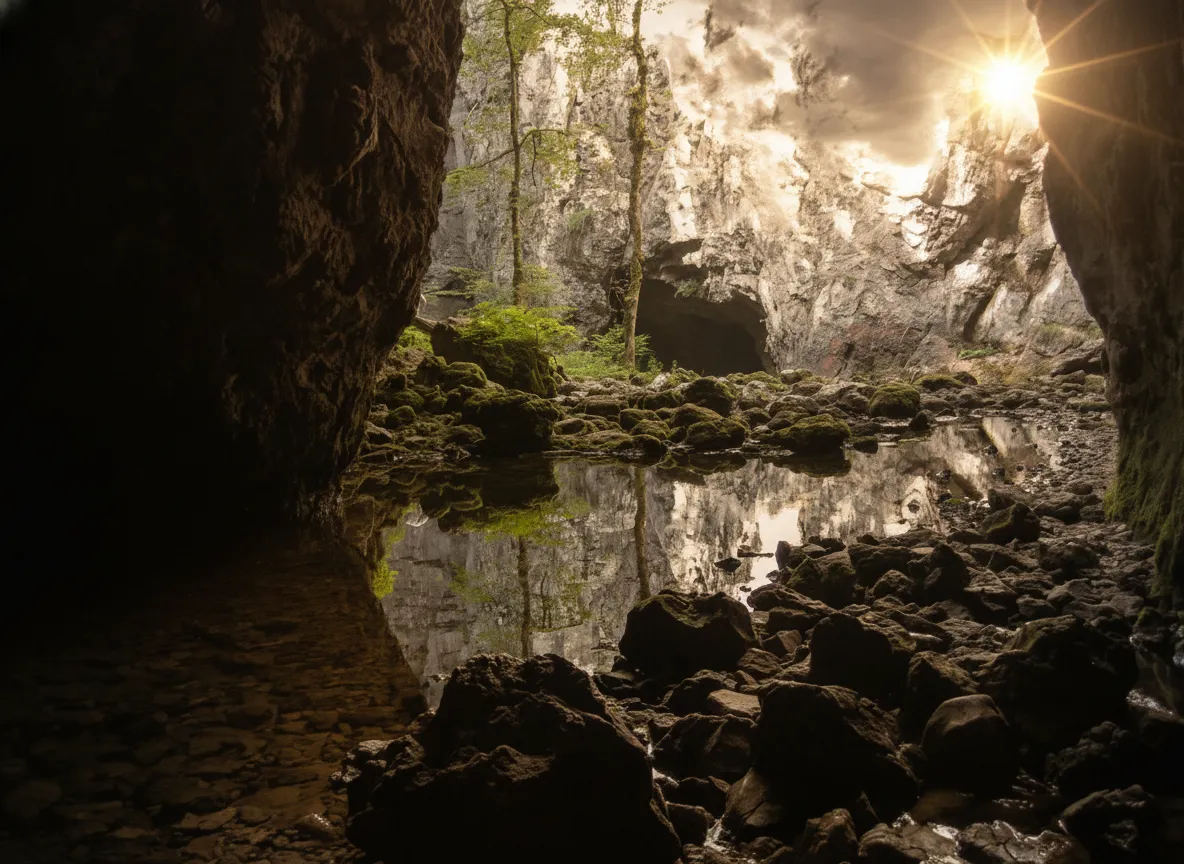
Imagine an entire subterranean world, so immense it collapsed, leaving behind monumental stone arches and a river that vanishes into the earth. It sounds like something out of a fantasy novel, doesn't it? Yet, tucked away in the heart of Slovenia's enigmatic Inner Carniola region, such a place not only exists but thrives with an otherworldly beauty that defies easy description. This isn't just a valley; it's the exposed skeleton of a forgotten giant, a place where the planet's inner workings are laid bare for all to witness. Welcome to Rakov Škocjan, a hidden gem that promises to redefine your understanding of natural wonders and leave you utterly spellbound.
Rakov Škocjan: Where a Subterranean World Broke Through to the Light
Rakov Škocjan isn't merely a picturesque landscape; it's a dramatic, living testament to the power of water and time. This extraordinary karst valley is, quite literally, the 'skeletal' remnant of a vast ancient cave system, a grotto of unimaginable scale that once existed entirely underground. Over millennia, the relentless work of water eroded the limestone, hollowing out chambers until, eventually, the immense ceiling could no longer support itself. It collapsed, revealing what were once hidden passages to the open sky.
What remains is an open-air canyon of breathtaking geological grandeur, a natural amphitheater carved by the very forces that shaped it. Here, the Rak River, the valley's lifeblood, embarks on a fascinating journey. It flows through this exposed cave system, gracefully navigating around towering rock formations and, most spectacularly, passing beneath two magnificent natural bridges: the 'Small' and 'Large' Natural Bridges. These aren't just scenic viewpoints; they are the last vestiges of the original cave roof, monumental stone arches that stand as silent sentinels to a lost world. After its dramatic surface display, the Rak River, true to its karst nature, mysteriously disappears once more into subterranean passages, continuing its hidden work beneath the earth. Visiting Rakov Škocjan is like peeking into the exposed guts of a planet-sized grotto, a truly unique experience that offers a profound connection to Earth's geological past.

A Geological Masterpiece: The Story of Rakov Škocjan's Formation
To truly appreciate Rakov Škocjan, one must understand the incredible forces that sculpted it. Slovenia sits squarely in the Dinaric Karst region, an area renowned globally for its unique geological formations. Karst landscapes are characterized by soluble bedrock, primarily limestone, which is highly susceptible to erosion by water. Over millions of years, rainwater, slightly acidic from absorbing carbon dioxide, seeps into cracks and fissures in the limestone, slowly dissolving it and carving out intricate networks of underground caves, sinkholes (dolines), and disappearing rivers.
The story of Rakov Škocjan began deep beneath the surface, where the Rak River, originating from the nearby Cerknica Lake (another fascinating karst phenomenon), carved a vast system of underground tunnels and chambers. Imagine a colossal river flowing through pitch-black caverns, relentlessly eating away at the rock. As these underground spaces grew larger, the immense weight of the overlying rock became too much for the cave ceilings to bear. Geologists believe a series of catastrophic collapses occurred, gradually transforming the subterranean realm into the open-air canyon we see today. The 'Small' and 'Large' Natural Bridges are not bridges in the traditional sense, but rather the last remaining sections of the original cave roof that somehow defied gravity and erosion, standing firm as monumental archways. This ongoing process of erosion and collapse continues to shape the landscape, making Rakov Škocjan a dynamic, living geological laboratory.
Exploring the Valley of Vanishing Waters: What Awaits You
A visit to Rakov Škocjan is an immersive journey into a landscape unlike any other. The valley is a protected landscape park, ensuring its pristine beauty is preserved for generations. Well-marked walking trails wind through the canyon, offering various perspectives of its dramatic features and allowing you to explore at your own pace.
Your adventure will likely begin with the awe-inspiring **Large Natural Bridge (Veliki Naravni Most)**. This colossal archway spans an impressive 40 meters, a truly magnificent sight that makes you feel tiny in comparison. The Rak River flows directly beneath it, carving its path through the limestone. Standing here, looking up at the sheer scale of the arch, you can almost hear the echoes of the ancient river that once flowed entirely in darkness. The surrounding cliffs are often draped in lush vegetation, adding vibrant greens to the grey-white rock.

Further along, you'll discover the **Small Natural Bridge (Mali Naravni Most)**. While smaller in scale, it is no less captivating. Here, the river emerges from a short, open-air passage before disappearing again into the Zelške Jame cave system. The area around the Small Natural Bridge is particularly enchanting, with the river often appearing calm and reflective before its dramatic plunge underground. You can often walk right up to the point where the river vanishes, a truly mesmerizing experience.
The **Rak River** itself is a central character in this geological drama. Its journey through the valley is a constant marvel, appearing and disappearing, flowing through open stretches, beneath natural bridges, and into dark cave entrances like Tkalca Jama and Zelške Jame. These caves are part of a vast hydrological system, with the water eventually re-emerging miles away at Planinsko Polje, a testament to the interconnectedness of karst landscapes.
Beyond the geological wonders, Rakov Škocjan is a haven for biodiversity. The unique microclimate within the valley supports a rich variety of flora and fauna. Keep an eye out for rare plants clinging to the cliff faces, listen for the calls of various bird species, and perhaps even spot some of the unique amphibians and insects that thrive in this environment. The air is fresh, often carrying the scent of damp earth and pine, creating a truly sensory experience. There's also the charming **Hotel Rak**, a historic building within the park, which provides a lovely spot for a break or a meal, and offers a glimpse into the human history of this wild place.

Your Essential Guide to Visiting Rakov Škocjan
Ready to embark on your adventure to Rakov Škocjan? Here's what you need to know to make your visit unforgettable:
Best Time to Visit: Rakov Škocjan is stunning year-round, but each season offers a different charm. Spring (April-May) is glorious, with lush greenery, abundant wildflowers, and the river often at its highest flow. Autumn (September-October) brings a spectacular display of fall foliage, painting the valley in hues of gold, red, and orange. Summer (June-August) is pleasant for hiking, though it can get warm, while winter, with a dusting of snow, transforms the landscape into a tranquil, almost mystical wonderland. For photography and comfortable hiking, spring and autumn are often ideal.
How to Get There: Rakov Škocjan is best reached by car, offering the flexibility to explore at your own pace. It's conveniently located in Inner Carniola, not far from Slovenia's capital, Ljubljana (approx. 45-minute drive). It's also an excellent addition to any itinerary visiting the famous Postojna Cave and Predjama Castle, as it's just a short drive from these popular attractions. Follow signs towards Cerknica, then for Rakov Škocjan. There are well-marked parking areas within the park.
What to Bring:
- Comfortable Walking Shoes: The trails are generally well-maintained but can be uneven in places, especially if you venture off the main paths. Sturdy hiking shoes are recommended.
- Water and Snacks: While there's Hotel Rak, it's always wise to carry your own water, especially on longer walks.
- Camera: You'll want to capture the breathtaking beauty of this place. A wide-angle lens is fantastic for the expansive views.
- Layers of Clothing: The valley can be cooler than the surrounding areas, especially near the river, so layers are a good idea.
- Rain Gear: Slovenian weather can be unpredictable, so a light rain jacket is always a smart addition.
- Insect Repellent: Especially during warmer months, to ward off mosquitoes.
Accessibility: The main trails are generally easy to moderate, suitable for most fitness levels. Some paths might have steps or uneven terrain. If you have mobility concerns, check specific trail conditions beforehand, but the views from the main viewpoints are accessible.
Respecting Nature: Rakov Škocjan is a protected landscape park. Please stick to marked trails, do not disturb wildlife, take all your trash with you, and leave no trace of your visit. Help preserve this incredible natural wonder for future generations.
Rakov Škocjan is more than just a destination; it's an experience that awakens a sense of wonder and deep appreciation for the Earth's geological artistry. It’s a place where you can touch the raw power of nature, walk through a landscape that was once hidden from human eyes, and witness a river's epic, vanishing journey. So, if you're seeking an adventure off the beaten path, a place where history is written in stone and the beauty is truly profound, make your way to this magnificent Slovenian secret. You won't regret it.
Essential Travel Information
- Location Rakov Škocjan, Slovenia
- Best Time Spring (April-May) for lush greenery and high water, or Autumn (September-October) for vibrant fall foliage.
- Getting There Best reached by car. Approximately 45 minutes drive from Ljubljana. Follow signs towards Cerknica, then Rakov Škocjan. Free parking available.
- Airport Ljubljana Jože Pučnik Airport (LJU)
- Budget Budget to Mid-range. Park entry is free; costs include travel, food (e.g., at Hotel Rak), and optional nearby accommodation. Approximate daily cost: €30-€70 (excluding major accommodation).
- Language Slovenian (English widely understood in tourist areas)
Find Places to Stay Near Rakov Škocjan
Compare hotels, hostels, and unique stays in Slovenia.
Search AccommodationTours & Experiences Near Rakov Škocjan
Book guided tours, day trips, and unique experiences.
Browse Tours