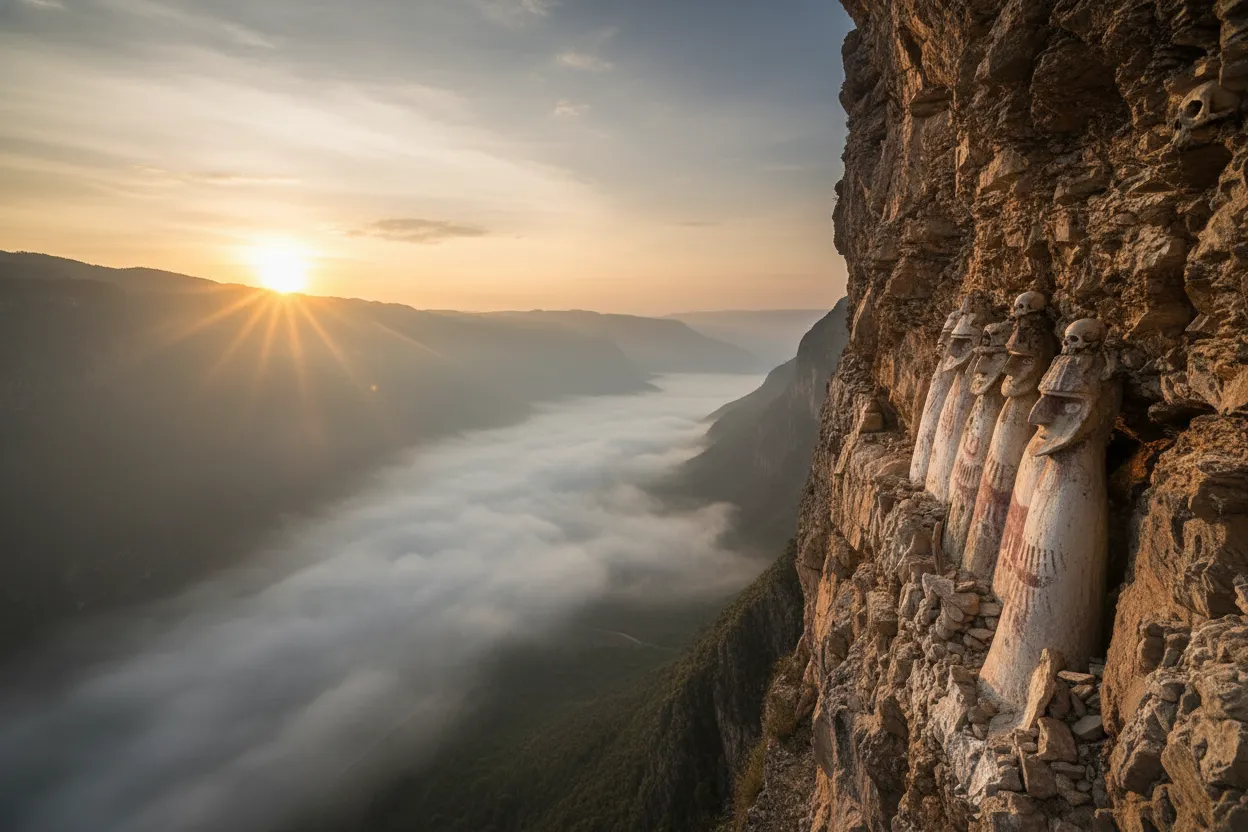
Imagine ancient, human-shaped coffins, some over two meters tall, standing sentinel on an impossible-to-reach cliff face for centuries. Now, picture them not in a dusty museum, but high above a verdant valley in the remote Peruvian Andes, guarding secrets of a civilization long lost to time. This isn't a scene from an Indiana Jones movie; this is the very real, utterly breathtaking sight of the Sarcophagi of Karajía (Sarcófagos de Karajía), one of Peru's most astonishing and least-known archaeological wonders. If you crave adventure, a deep dive into ancient mysteries, and a travel experience that will genuinely leave you speechless, then buckle up – because we’re about to uncover the secrets of the Cloud People.
The Guardians of the Clouds: What Makes Karajía So Special?
Perched precariously on a limestone cliff face, hundreds of feet above the valley floor, the Sarcophagi of Karajía are not just unique; they are a profound testament to the ingenuity and spiritual depth of the Chachapoyas people. Often referred to as the "Warriors of the Clouds," this pre-Inca civilization flourished in what is now Peru's Amazonas Region long before the Inca Empire rose to prominence. Unlike the grand stone cities of the Inca, the Chachapoyas left behind a legacy that is both bizarre and beautiful: incredible burial structures that defy gravity and time.
What sets Karajía apart is the sheer audacity of its location and the distinctive form of its 'purunmachus' – the local term for these anthropomorphic sarcophagi. Crafted from clay, straw, and small stones, then painted with mineral pigments, these figures are not just coffins; they are imposing, almost cartoonish, yet deeply reverent representations of the deceased. Each one is a guardian, a silent witness to centuries of history, their watchful eyes gazing out over the Utcubamba Valley. They stand in a row, like a silent council of elders, embodying a funerary art form found nowhere else in the world.

The very act of creating and placing these massive structures in such an inaccessible spot speaks volumes about the Chachapoyas' beliefs. It was a feat of engineering, faith, and sheer determination, intended to protect their most revered ancestors – likely elite members of their society – from both the elements and grave robbers. To stand before them, even at a distance, is to feel a palpable connection to a forgotten world, to an ancient people who held profound reverence for their dead and possessed an extraordinary capacity for monumental art.
Whispers from the Past: History of the Cloud People and Their Burials
The Chachapoyas civilization thrived from approximately 800 AD until their eventual conquest by the Inca in the late 15th century, and later by the Spanish. Their domain was a rugged, mountainous cloud forest, a landscape that shaped their culture and architectural styles. They were skilled warriors, farmers, and artisans, known for their distinctive pottery, textiles, and, of course, their unique burial practices.
The Sarcophagi of Karajía date back to roughly the 15th century, just before the Inca conquest. For the Chachapoyas, death was not an end but a transition, and their ancestors played a crucial role in the spiritual and daily life of the community. Mummification was a common practice among the elite, and these mummified remains were then carefully placed inside the 'purunmachus'. The sarcophagi themselves were likely constructed in sections on the ground, then painstakingly hoisted and assembled in their final resting places on the cliff ledges, a logistical marvel given the lack of modern tools.
The choice of such a high, inaccessible cliff face was deliberate. It offered natural protection from landslides, floods, and human disturbance, ensuring the eternal rest of their revered ancestors. The location also held spiritual significance, placing the deceased closer to the heavens and perhaps allowing them to oversee and protect their living descendants in the valley below. These 'purunmachus' are not merely containers; they are active participants in the landscape, a continuous dialogue between the living and the dead.
Remarkably, the Sarcophagi of Karajía remained largely undisturbed and unknown to the outside world until their "rediscovery" in 1985 by a team of archaeologists led by Federico Kauffmann Doig. This relative isolation has preserved them in an astonishing state, offering invaluable insights into the Chachapoyas' funerary customs, artistic expression, and worldview.
A Glimpse into Eternity: What You'll See at Karajía
Your journey to Karajía is an adventure in itself, a scenic drive through the breathtaking landscapes of the Amazonas region, followed by a rewarding hike. As you approach the viewing area, the first glimpse of the sarcophagi is nothing short of magical. Suddenly, there they are: a line of six (originally seven, one fell due to an earthquake) towering figures, each over two meters tall, clinging to the sheer rock face. They appear almost impossibly balanced, a testament to the ancient builders' skill and the enduring power of their creations.

From the designated viewpoint, you'll be able to observe the intricate details of these unique structures. Each sarcophagus typically features a prominent head, often with a flattened, almost bird-like face, T-shaped noses, and painted eyes that seem to peer into your soul. Some bear evidence of elaborate headdresses or facial decorations, suggesting the status of the individual within. Their bodies are cylindrical, tapering slightly, and often adorned with geometric patterns or symbols that likely held deep cultural and spiritual meaning. The base of the sarcophagi is often anchored with small ledges or crevices in the cliff, a clever design to secure them against the elements.
The sense of wonder is profound. You'll feel a hush fall over you as you contemplate the sheer scale of the effort involved and the mysteries these silent guardians hold. The wind whispers through the valley, carrying with it the faint echoes of a forgotten past. It's a place that encourages quiet contemplation, a deep appreciation for human ingenuity, and a renewed sense of connection to the ancient world. Don't forget your binoculars to truly appreciate the craftsmanship from a distance!
Your Journey to the Clouds: Practical Tips for Visiting Karajía
Venturing to Karajía is an unforgettable experience, but it requires a bit of planning. Think of it as an adventure that rewards the prepared traveler:
Getting There:
Your base for exploring Karajía and other Chachapoyas sites will be the charming city of Chachapoyas. From Chachapoyas, you can hire a taxi or take a shared colectivo (a local mini-van) to the village of Cruzpata (near Luya and San Bartolo). From Cruzpata, it's a scenic, downhill walk of about 20-30 minutes to the viewing platform for the sarcophagi. The path is well-maintained but can be a bit steep in places, so comfortable hiking shoes are essential. Many travelers opt for an organized tour from Chachapoyas, which simplifies logistics and provides valuable historical context.
Best Time to Visit:
The dry season, from May to September, is generally considered the best time to visit. The weather is more stable, with clearer skies and less chance of rain, making for more pleasant hiking conditions and better visibility of the sarcophagi. The wet season (October to April) can bring heavy rains, making some paths slippery and potentially obscuring views.
What to Bring:
- **Good Hiking Shoes:** Essential for the walk to the viewing platform.
- **Water & Snacks:** There are limited facilities once you leave the main towns.
- **Sun Protection:** Hat, sunglasses, and sunscreen are a must, even on cloudy days.
- **Rain Gear:** A lightweight rain jacket or poncho is always a good idea, regardless of the season, as mountain weather can change quickly.
- **Camera:** You'll want to capture these incredible views!
- **Binoculars:** Highly recommended for a closer look at the sarcophagi's details.
- **Small Backpack:** To carry your essentials comfortably.

Respectful Tourism:
Remember that Karajía is a sacred archaeological site. Always stick to marked paths, do not attempt to approach the sarcophagi (it's both dangerous and illegal), and leave no trace of your visit. Support local communities by purchasing goods or services from them.
A journey to the Sarcophagi of Karajía is more than just a trip; it's an expedition into the heart of ancient Peru, a chance to witness the enduring legacy of the Chachapoyas people. It’s a place that challenges your perceptions of history, art, and what's possible, leaving you with memories that will last a lifetime. So, if you're ready to step off the beaten path and into a world of ancient wonders, Karajía awaits.
Essential Travel Information
- Location Sarcophagi of Karajía (Sarcófagos de Karajía), Peru
- Best Time May to September (dry season)
- Getting There From Chachapoyas city, take transport to Cruzpata village, then a 20-30 minute downhill hike to the viewpoint.
- Airport Jaén (JAE) or Chachapoyas (CHH)
- Budget Mid-range (approx. $50-100 USD daily for region activities/transport/food, excluding international flights)
- Language Spanish
Find Places to Stay Near Sarcophagi of Karajía (Sarcófagos de Karajía)
Compare hotels, hostels, and unique stays in Peru.
Search AccommodationTours & Experiences Near Sarcophagi of Karajía (Sarcófagos de Karajía)
Book guided tours, day trips, and unique experiences.
Browse Tours