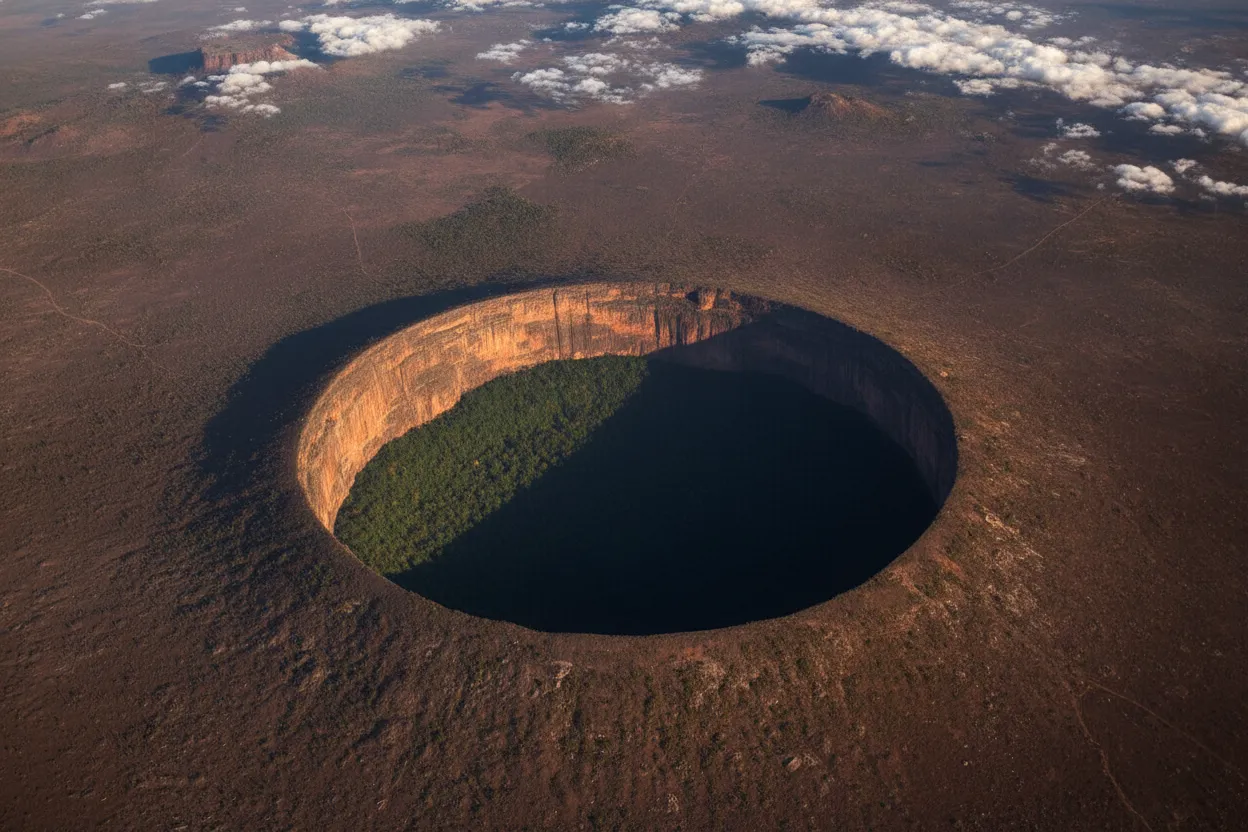
Imagine a place so remote, so untouched, that it feels like a secret whispered from the very dawn of time. A place where the earth itself has sculpted wonders so profound, they defy easy explanation. Far from the well-trodden paths of tourism, nestled deep within the ancient heart of Venezuela’s Bolívar state, lies such a marvel: the Sarisariñama Sinkholes. On an isolated, ancient tabletop mountain, known locally as a tepui, exist perfectly circular sinkholes so immense and deep that they harbor unique, isolated ecosystems at their untouched bottoms. This isn't just a destination; it's a geological enigma, a biological treasure chest, and a journey into a lost world that continues to guard its mysteries.
The Enigma of Sarisariñama: A Geological Marvel
The Sarisariñama tepui, a colossal sandstone mesa rising dramatically from the surrounding jungle, is itself a spectacle. But it's what lies within its flat, forested summit that truly captivates the imagination. Here, carved with unnerving precision into the ancient rock, are the Sarisariñama Sinkholes – colossal, perfectly circular depressions that plunge hundreds of meters into the earth. These aren't your typical caverns or eroded potholes; their sheer, smooth walls drop vertically, creating a breathtaking, almost otherworldly spectacle.
The two most famous and largest sinkholes, Sima Humboldt and Sima Martel, are staggering in their dimensions. Each measures up to 350 meters (over 1,100 feet) in both diameter and depth. To put that into perspective, imagine standing at the edge of a chasm wider than a football field and deep enough to swallow the Eiffel Tower with room to spare. The sheer scale is difficult to comprehend until you witness it. From above, they appear like two perfectly punched holes in a giant green cake, their dark, forested bottoms hinting at a hidden world far below. What geological forces could have created such perfect, sheer-walled cylinders in solid sandstone remains a subject of intense scientific debate and fascination.

This geological puzzle is one of Sarisariñama's most compelling draws. Theories range from ancient cave collapses to a unique form of chemical erosion, but no single explanation fully accounts for their immaculate circularity and verticality. It's a testament to the raw, unpredictable power of nature and the enduring mysteries our planet still holds.
A Glimpse into Geological Time: History and Discovery
Despite the immense size of the Sarisariñama Sinkholes, they remained largely unknown to the outside world until the 1970s. The remote location of the tepui, deep within the inaccessible jungles of Bolívar, Venezuela, meant that it was effectively a "lost world" for centuries. Indigenous Pemon communities have lived in the region for millennia, with their own legends and knowledge of the tepuis, but the specific geological wonders of Sarisariñama were not widely documented.
It was in 1961 that the first aerial reconnaissance by American pilot and explorer Harry Gibson confirmed the existence of these extraordinary formations. However, it wasn't until 1974 that the first expedition, led by Venezuelan biologist and explorer Charles Brewer-Carías, successfully reached the bottom of Sima Humboldt. This pioneering descent was a monumental undertaking, requiring specialized equipment and an intrepid spirit to navigate the treacherous terrain and the unknown depths. The discovery sent ripples through the scientific community, revealing a pristine, isolated ecosystem untouched by human influence for millennia.
Since then, only a handful of scientific expeditions have been granted access to these fragile environments, each one meticulously planned and executed. The focus has always been on research and conservation, ensuring that the unique ecosystems within remain as undisturbed as possible. This relatively recent discovery and the ongoing scientific study underscore the incredible value of Sarisariñama – not just as a natural wonder, but as a living laboratory providing insights into evolution and biodiversity.
Life in the Depths: A World Apart
The true magic of the Sarisariñama Sinkholes lies not just in their geological grandeur, but in the incredible biodiversity they harbor. Imagine a world cut off from the outside by hundreds of meters of vertical rock. At the bottom of these colossal pits, isolated forests thrive, creating unique microclimates and evolutionary pressures. Sunlight filters down, creating a humid, sheltered environment where life has evolved in splendid isolation.

The species found at the bottom of Sarisariñama's sinkholes are often endemic, meaning they exist nowhere else on Earth. Scientists have discovered new species of plants, insects, amphibians, and even small mammals that have adapted to this unique, sun-dappled, and perpetually damp environment. These "lost worlds" within a lost world are like natural time capsules, offering a glimpse into ancient ecosystems and the fascinating processes of speciation. The dense, pristine forests at the bottom are a stark contrast to the sparser vegetation on the tepui's rim, illustrating the dramatic impact of environmental isolation.
Exploring these depths, even vicariously through scientific reports, evokes a sense of wonder and reverence. It's a powerful reminder of the planet's hidden treasures and the importance of preserving such pristine environments. The sheer scale of the sinkholes means that the journey down is an epic descent into a miniature, self-contained world, a true testament to the resilience and adaptability of life.
Journey to the Lost World: Practicalities and Aspirations
Let's be upfront: a visit to the Sarisariñama Sinkholes is not your typical tourist excursion. This is an expedition into one of the planet's most remote and challenging environments, reserved for serious adventurers, scientific researchers, and those with significant resources and preparation. The logistical hurdles are immense, but for those who dream of truly unexplored frontiers, the aspiration remains potent.
Access begins in Venezuela, often requiring chartered flights from major cities like Caracas or Puerto Ordaz to remote airstrips in the Bolívar state. From there, the journey involves multi-day treks through dense jungle, navigating challenging terrain, and potentially further helicopter transfers to reach the tepui's summit. Reaching the rim of the sinkholes requires expert guides, and any descent into the sinkholes themselves is an even more specialized operation, demanding highly skilled mountaineers, cavers, and extensive safety protocols. Permits from Venezuelan authorities are absolutely essential and are typically granted only for scientific research or highly organized, conservation-focused expeditions.

The experience, however, for those few who manage it, is unparalleled. Standing at the rim, gazing into the abyss, feeling the cool, moist air rising from the depths, and knowing that beneath you lies a world virtually untouched by humanity – it's a moment that transcends ordinary travel. It's a profound connection to the raw, untamed essence of our planet, a testament to its enduring power to surprise and inspire.
While direct access may be a distant dream for most, the story of Sarisariñama reminds us of the incredible wonders that still exist in our world, hidden away, waiting to be discovered or simply revered from afar. It's a place that beckons the imagination, a symbol of the wild, mysterious heart of Venezuela, and a compelling reason to protect these invaluable natural treasures for generations to come.
Essential Travel Information
- Location Sarisariñama Sinkholes, Venezuela
- Best Time Dry season (December to April) for slightly easier expedition conditions, though conditions remain challenging year-round.
- Getting There Extremely difficult and expensive. Requires chartered flights to remote airstrips in Bolívar state (e.g., La Paragua), followed by multi-day treks through dense jungle and potentially helicopter transfers. Special permits and highly specialized expedition organizers are mandatory. Not accessible by public transport or casual tourism.
- Airport Puerto Ordaz (PZO) for regional connections, otherwise Simón Bolívar International Airport (CCS) in Caracas for international access.
- Budget Luxury/Expeditionary (Likely $500-$1500+ per person per day for a fully organized, permitted expedition, if available).
- Language Spanish
Find Places to Stay Near Sarisariñama Sinkholes
Compare hotels, hostels, and unique stays in Venezuela.
Search AccommodationTours & Experiences Near Sarisariñama Sinkholes
Book guided tours, day trips, and unique experiences.
Browse Tours