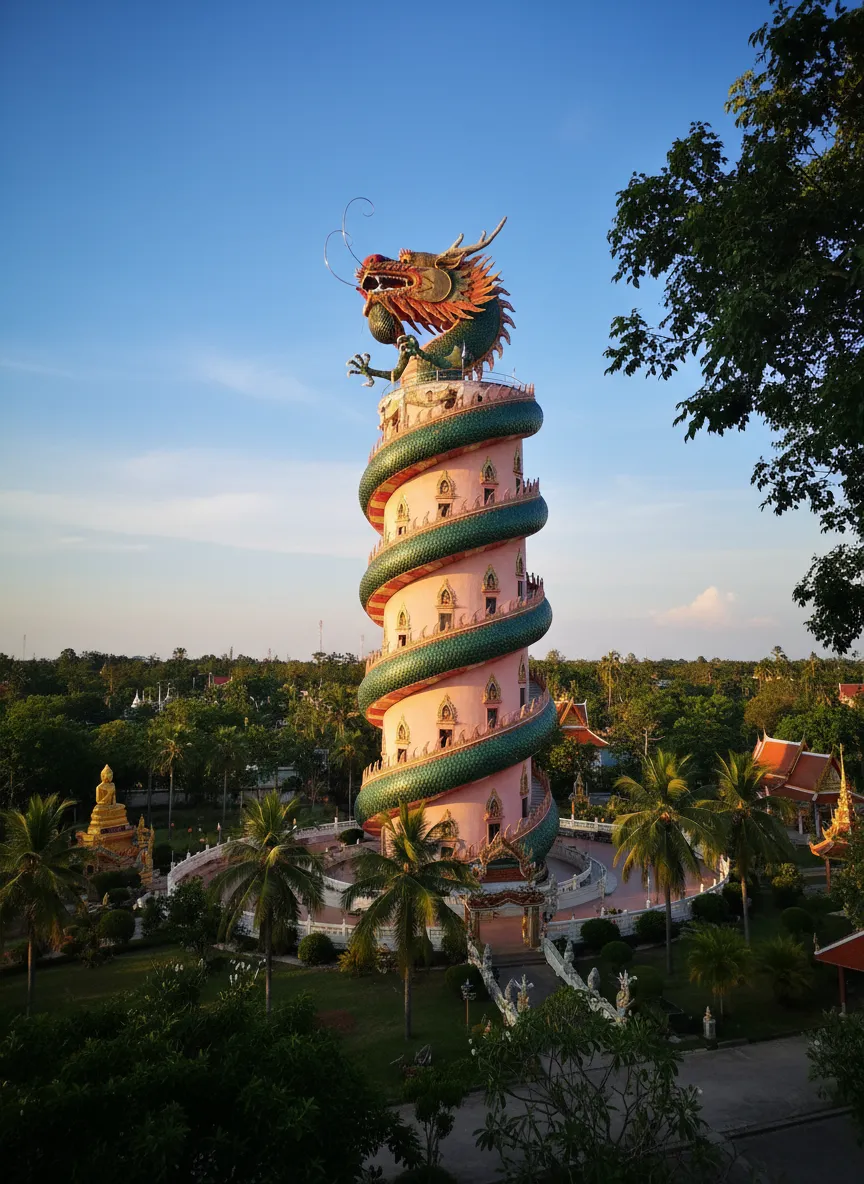
Imagine this: You’re exploring the vibrant, chaotic beauty of Thailand, perhaps just a stone’s throw from the bustling heart of Bangkok, yet you stumble upon something so utterly fantastical, it feels plucked from the pages of a mythical tale. A towering pink temple, seemingly embraced by an enormous, emerald-green dragon, spirals skyward into the clouds. Its scales glimmer, its claws grip, and its head stares down with an ancient, knowing gaze. This isn't a dream, nor a movie set, but the breathtaking reality of Wat Samphran, often known simply as the Dragon Temple – a truly hidden gem that promises an adventure unlike any other.
For most international tourists, Thailand conjures images of pristine beaches, bustling markets, and gilded ancient temples. But what if I told you there's a place that shatters all expectations, an architectural marvel so bizarre and awe-inspiring it feels like it belongs on another planet? Wat Samphran is that place. Tucked away in Nakhon Pathom Province, just an hour or so outside of Bangkok, this 17-story wonder remains largely unknown, a secret whispered among adventurous travelers and locals. It’s a vibrant, spiritual landmark that offers not just a feast for the eyes, but a literal climb into the belly of a beast – a journey you won't soon forget.
What Makes Wat Samphran So Special?
The sheer visual impact of Wat Samphran is what immediately sets it apart. It’s not just a temple; it’s a colossal sculpture, a fusion of spiritual devotion and audacious imagination. The main temple building is a striking shade of pink, symbolizing the day of the week it was built (Tuesday, which is associated with pink in Thai culture). But it's the colossal green dragon that truly steals the show. This magnificent creature coils around the entire 17-story structure, its body forming a hollow pathway that leads all the way to the summit. Yes, you read that right – you can actually walk *inside* the dragon!
This isn't a museum piece or a distant monument; it's an interactive, living temple. The dragon's body, meticulously detailed with scales, claws, and a fierce head, serves as an internal staircase. Climbing it is a surreal experience, a pilgrimage through the mythical beast's very essence. As you ascend, the light filters in through various openings, offering glimpses of the surrounding countryside, each view more breathtaking than the last. It’s a journey that combines physical exertion with a sense of wonder, culminating in panoramic vistas that stretch across the Nakhon Pathom landscape.
What makes this Dragon Temple even more special is its relative obscurity. While millions flock to Thailand's more famous sites, Wat Samphran remains largely off the main tourist radar. This means fewer crowds, a more authentic experience, and the thrilling sensation of discovering something truly unique. It’s a testament to the fact that even in well-trodden destinations, incredible secrets still await those willing to venture slightly off the beaten path.

A Journey Through Myth: The History & Symbolism
Unlike many ancient temples in Thailand, Wat Samphran is a relatively modern creation, built in 1985 by Phra Kru Phawana Wittaya Thera (also known as Luangpor Chamnan). This adds another layer to its fascinating story – it's not a relic of a bygone era, but a contemporary masterpiece born from a visionary's dream. The exact inspiration for the dragon's design isn't widely documented, but its presence is deeply rooted in Thai Buddhist culture and folklore.
In Thai mythology and Buddhism, dragons (Nagas) are powerful, benevolent beings, often associated with water, wisdom, and protection. They are guardians of sacred places and symbols of cosmic power. The dragon at Wat Samphran, therefore, isn't just a decorative element; it's a symbolic protector of the temple's spiritual heart. Climbing inside it can be seen as a metaphorical journey through purification and enlightenment, guarded by this majestic mythical creature. The 17 stories of the temple are also significant, possibly representing various levels of Buddhist heavens or paths to enlightenment.
The temple's vibrant pink color, as mentioned, is often linked to the auspicious color for Tuesday. This attention to detail, from the color scheme to the intricate dragon scales, speaks volumes about the dedication and spiritual significance imbued into every aspect of its construction. It stands as a powerful testament to the enduring creativity and devotion found within Thai Buddhism.
Climbing the Dragon's Belly: What to Expect
Your adventure at Wat Samphran truly begins when you step into the dragon's body. The entrance is usually found at the base of the temple. Inside, a spiral staircase, sometimes a little uneven and dimly lit, winds its way up through the dragon's hollow core. As you ascend, you’ll pass through various sections of the dragon, feeling its massive presence all around you. It’s an immersive experience – the air might be a little cooler, the sounds muffled, and the sense of anticipation builds with every step.
Periodically, you'll encounter small windows or openings, offering tantalizing glimpses of the world outside. These are perfect photo opportunities, framing the lush Nakhon Pathom countryside through the dragon's scales. The climb itself, while unique, does require a moderate level of fitness. There are many steps, and while there are occasional resting spots, it’s a continuous ascent to the top. But trust me, the reward is absolutely worth it.
Upon reaching the dragon's head at the summit, you'll emerge onto an observation deck offering breathtaking 360-degree panoramic views. From here, you can gaze out over the vast green expanse of Nakhon Pathom, dotted with other temples, rice paddies, and local villages. It’s a truly serene and awe-inspiring moment, a stark contrast to the bustling energy of Bangkok. At the top, you'll also find various Buddha statues and smaller shrines, inviting quiet contemplation and offering merit for your journey.

Beyond the main Dragon Temple, the grounds of Wat Samphran hold other charming surprises. You'll find a beautiful, serene garden filled with various statues of mythical creatures, elephants, and other Buddhist symbols. Keep an eye out for the giant turtle statue, which houses a 7-story tunnel you can also walk through – another quirky, fascinating experience! There are also smaller, more traditional temple buildings and shrines, offering a quieter space for prayer and reflection. It’s worth taking your time to explore these peaceful surroundings after your epic dragon climb.

Planning Your Dragon Adventure: Practical Tips
Ready to embark on your own journey to this incredible Dragon Temple? Here are some practical tips to help you plan your visit to Wat Samphran:
-
How to Get There:
Wat Samphran is located in Nakhon Pathom Province, approximately 40-50 kilometers west of Bangkok. The easiest and most convenient way to get there is by private taxi or a ride-sharing service like Grab (though finding a Grab for the return journey might be trickier). The drive typically takes about an hour to an hour and a half, depending on traffic. You can negotiate a round-trip fare with a taxi driver. Alternatively, you can take a public van or bus from Bangkok (e.g., from Mo Chit or Southern Bus Terminal) to Nakhon Pathom town, and then take a local taxi or songthaew (shared pickup truck taxi) to the temple. Renting a car for the day is also a great option for flexibility.
-
Best Time to Visit:
The best time to visit Thailand, and consequently Wat Samphran, is during the cool, dry season from November to February. The weather is more comfortable for climbing. Aim to arrive early in the morning (around 8-9 AM) to avoid the midday heat and larger crowds, or in the late afternoon for beautiful golden hour lighting. The temple is generally open from 9 AM to 5 PM, but it’s always wise to double-check before your visit.
-
What to Wear & Temple Etiquette:
As it is a Buddhist temple, respectful attire is essential. This means covering your shoulders and knees. Loose-fitting, comfortable clothing is recommended, especially for the climb. Wear comfortable walking shoes, as you'll be ascending many stairs. Remember to remove your shoes before entering certain sacred buildings. Be mindful of your volume and behavior; maintain a respectful demeanor throughout your visit.
-
Cost:
Admission to Wat Samphran is typically free, though donations are always welcome and encouraged to help with the upkeep of the temple. You might encounter small fees for parking or specific activities, but generally, it’s a very budget-friendly destination.
-
Time Needed:
Allow at least 2-3 hours to explore the temple grounds and climb the dragon. If you’re coming from Bangkok, factor in another 2-3 hours for round-trip travel. This makes for a perfect half-day or full-day trip from the capital.
-
Food & Drink:
While there might be some small local stalls selling snacks and drinks on the temple grounds or nearby, options can be limited. It's a good idea to bring your own water, especially for the climb, and perhaps some light snacks.
Wat Samphran is more than just a temple; it's an experience, a journey into the fantastical, and a testament to the endless wonders that Thailand holds. If you're looking to peel back the layers of typical tourism and discover a truly unique, awe-inspiring place that will leave you with stories for a lifetime, then make sure this magnificent Dragon Temple is at the very top of your Thailand itinerary. It's a hidden gem waiting to be discovered, and a memory waiting to be made.
Essential Travel Information
- Location Wat Samphran (วัดสามพราน), Thailand
- Best Time November to February (cool, dry season)
- Getting There Taxi/Grab from Bangkok (1hr); Public van/bus to Nakhon Pathom, then local taxi.
- Airport Suvarnabhumi Airport (BKK)
- Budget Budget/Mid-range (Day trip from Bangkok approx. $50-100 USD including transport)
- Language Thai
Find Places to Stay Near Wat Samphran (วัดสามพราน)
Compare hotels, hostels, and unique stays in Thailand.
Search AccommodationTours & Experiences Near Wat Samphran (วัดสามพราน)
Book guided tours, day trips, and unique experiences.
Browse Tours